 +919325609388

 +919325609388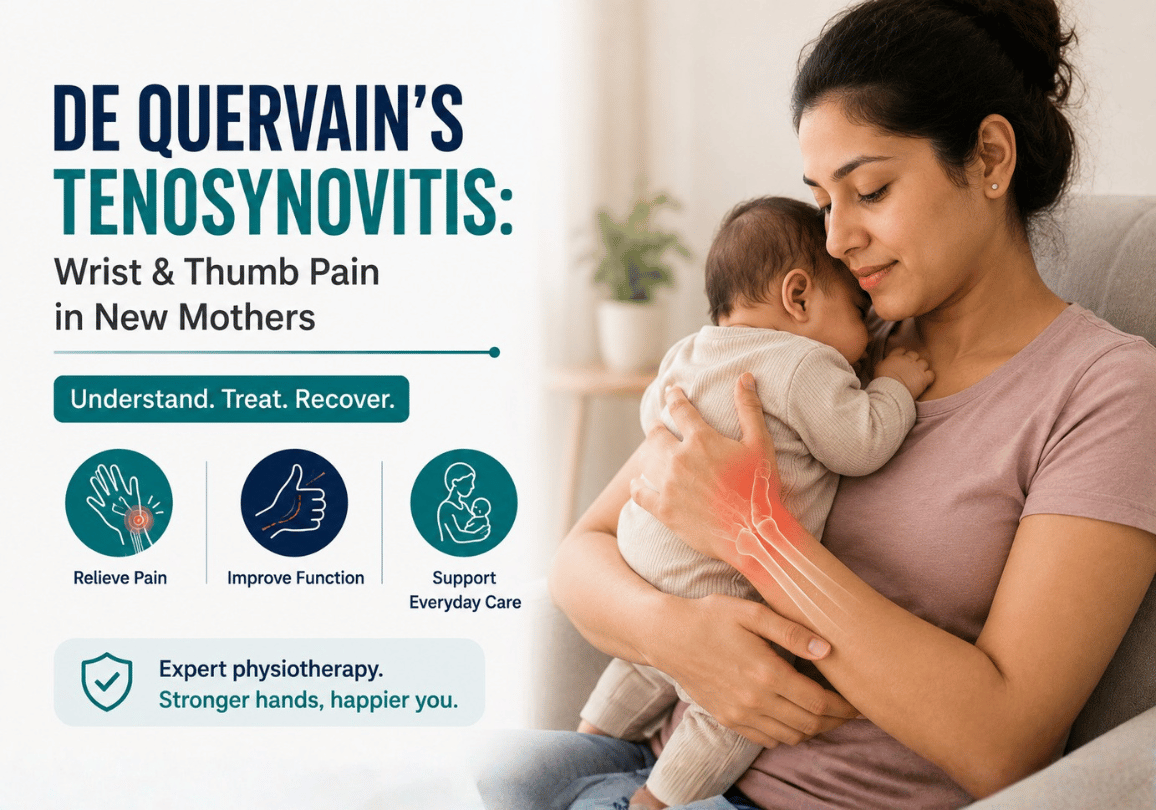
De Quervain’s Tenosynovitis: Wrist and Thumb Pain Explained for New Mothers
De Quervain’s tenosynovitis is one of the most common causes of postpartum wrist pain, affecting new mothers who spend their days lifting, holding, feeding, and caring for their newborn. It involves inflammation of two tendons on the thumb side of the wrist, and it has earned the informal name “mommy thumb” because of how frequently it appears in the months following childbirth. Knowing what it is, why it develops, and how physiotherapy can resolve it helps new mothers stop blaming themselves and start treating the real problem.
This guide explains the anatomy behind wrist tendon inflammation in new mothers, how to recognise it, how the Finkelstein test confirms the diagnosis, and what treatment and physiotherapy involve at each stage.
What Is De Quervain’s Tenosynovitis?
De Quervain’s tenosynovitis is a stenosing tenosynovitis of the first dorsal compartment of the wrist. In plain terms, the sheath surrounding two tendons that control thumb movement becomes inflamed, thickened, and constricted. As the tendons try to glide through this narrowed tunnel with each thumb or wrist movement, friction builds and pain results. The two tendons involved are Abductor pollicis longus (APL) and Extensor pollicis brevis (EPB).
Both tendons pass through a fibro-osseous tunnel at the base of the wrist, anchored by the extensor retinaculum. When these tendons are subjected to repetitive stress in positions of wrist flexion and ulnar deviation (bending the wrist toward the little finger), inflammation develops within the tunnel. This type of new mother wrist strain is extremely common during the first few postpartum months.
Why New Mothers Are at Higher Risk
A study published in Hand (SAGE Journals, 2024) identified specific postpartum risk factors for de Quervain’s tenosynovitis. First-time mothers were found to have more than a two-fold higher risk of developing the condition compared to experienced mothers, largely because they had not yet learned ergonomic lifting and holding techniques.
Several overlapping factors drive this elevated risk in the postpartum period:
- Repetitive lifting mechanics: A newborn is lifted 25 to 30 times daily, typically with the thumbs pointing outward and the wrists flexed and ulnar deviated. This specific posture is the primary mechanical trigger for first dorsal compartment inflammation.
- Breastfeeding and bottle-feeding position: Cradling a baby during feeding sessions places the supporting wrist in sustained flexion and ulnar deviation, maintaining the tendons under continuous load for extended periods multiple times per day.
- Hormonal changes: Elevated levels of relaxin and oestrogen during pregnancy and the postpartum period affect connective tissue remodelling, increasing tendon vulnerability.
- Physical deconditioning: Reduced grip and forearm strength during late pregnancy and the immediate postpartum period means tendons must absorb greater relative load with each lifting movement.
Research published in PMC (2025) found that de Quervain’s significantly affects a new mother’s ability to perform core parenting tasks, including lifting, nappy changes, bathing, and feeding. Participants described feeling unable to care for their babies independently, creating both physical and emotional distress.
Symptoms of Wrist and Thumb Tendon Inflammation
Symptoms typically develop gradually in the first weeks to months postpartum. Many women first notice thumb pain during breastfeeding because of prolonged wrist positioning during feeds. Key symptoms include:
- Pain on the thumb side of the wrist: A sharp or aching pain located at the radial styloid, the bony prominence at the outer wrist just above the base of the thumb.
- Pain with gripping, pinching, or twisting: Movements involving thumb-and-finger pinch, wringing a cloth, or lifting with fingers spread all provoke sharp discomfort.
- Swelling and thickening: Visible or palpable swelling over the first dorsal compartment at the base of the thumb is common. The tendon sheath may feel thickened to the touch.
- Clicking or snapping sensation: As inflamed tendons move through the constricted sheath, a palpable or audible catching sensation may occur with movement.
- Pain at night or during rest: Inflammatory swelling causes discomfort even without active movement, particularly in the acute phase.
- Weakness in thumb and wrist: Secondary to pain inhibition, grip strength and pinch strength are often reduced, making basic infant care tasks difficult.
Finkelstein Test: Confirming Diagnosis at Home or in Clinic
De Quervain’s tenosynovitis is primarily a clinical diagnosis. According to StatPearls/NCBI, the Finkelstein test is the standard provocative test used to confirm the condition. It remains one of the most reliable physical examination tests in hand and wrist assessment.
The test is performed in three steps:
- Sit with the forearm resting on a flat surface in a neutral position, neither palm-up nor palm-down.
- Fold the thumb into the palm and wrap the four fingers over it to form a loose fist.
- Gently tilt the wrist downward toward the little-finger side (ulnar deviation). The examiner may assist with passive deviation.
A positive result is sharp pain reproduced over the radial wrist and first dorsal compartment, matching the patient’s familiar pain. Mild discomfort during ulnar deviation can occur in normal wrists, which is why Orthofixar recommends performing the test bilaterally and comparing both sides. The test is considered positive only when the patient’s typical symptoms are reproduced.
Imaging investigations, including X-ray to exclude bony pathology and ultrasound to visualise tendon sheath thickening, are used in Pune when the diagnosis is uncertain or when symptoms do not respond as expected to initial treatment.
Treatment Options: From Activity Modification to Surgery
Treatment for de Quervain’s tenosynovitis in new mothers follows a stepwise approach, beginning with conservative measures and progressing only if symptoms persist. Hand Surgery and Rehabilitation (2024) publication found that corticosteroid injection is 1.61 times more likely to resolve symptoms compared to immobilisation alone, and that combining injection with splinting provides the greatest benefit.
| Treatment Option | When Used | Success Rate | Notes for New Mothers |
| Activity modification and rest | First-line; all stages | Symptom improvement in most mild cases | Reduce repetitive thumb pinch and ulnar deviation. Modify baby-lifting technique immediately. |
| Thumb spica splint | First-line; acute and sub-acute | 19% improvement with splint alone; 57% with splint and NSAIDs (Physiopedia) | Worn for a minimum of 6 weeks. Can be used during feeds with a nursing pillow for wrist support. |
| Corticosteroid injection | First or second-line | 83% cure rate with injection alone (PubMed); 73.4% success within 2 injections | Consult a treating doctor regarding breastfeeding safety. Evidence supports use in lactating women with appropriate guidance. |
| Physiotherapy | Throughout all stages | Improves strength, mobility and prevents recurrence | Tendon gliding, eccentric strengthening, ergonomic education. Essential for long-term recovery. |
| Surgery | Resistant cases only (over 6 months conservative failure) | High success; lowest recurrence rate in nursing women | Performed under local anaesthesia. Consideration when conservative measures fail. |
Physiotherapy for De Quervain’s Tenosynovitis in New Mothers
Physiotherapy is the foundation of safe, sustainable recovery from de Quervain’s tenosynovitis, particularly for new mothers who cannot significantly reduce daily physical demands. A physiotherapist trained in hand and wrist rehabilitation will assess the stage of inflammation, current functional limitation, and specific aggravating postures before designing an individual programme. Tenosynovitis physiotherapy focuses on reducing tendon friction, improving thumb mechanics, and preventing recurrence.
A structured physiotherapy programme covers the following:
- Tendon gliding exercises: Controlled sequences of thumb and finger movements that encourage the inflamed tendons to glide smoothly through the sheath without excess friction.
- Wrist and forearm stretching: Ulnar deviation stretches with the thumb tucked under the fingers, wrist flexion and extension stretches, and forearm pronation and supination movements are performed to maintain tissue extensibility.
- Isometric strengthening: Submaximal thumb and grip contractions against resistance begin the strengthening phase once pain is controlled. Isometric work avoids the friction of tendon movement while rebuilding musculotendinous load tolerance.
- Eccentric loading progression: Using light resistance bands, the wrist and thumb progress through eccentric (lengthening under load) exercises in flexion, extension, radial and ulnar deviation.
- Thumb pinch and grip strengthening: Gentle putty exercises for chuck pinch, lateral pinch, and thumb opposition, rebuild the functional strength needed for infant care.
- Ergonomic education: A central component of physiotherapy for new mothers is teaching safe lifting and holding technique, breastfeeding positioning, and use of adaptive equipment.
Safer Lifting and Holding Techniques for New Mothers
Modifying how a mother lifts and holds her baby is one of the most immediately effective interventions available. Key adjustments recommended by hand therapists and physiotherapists include:
- Scoop lifting: Instead of lifting under the armpits with thumbs and fingers forming an L-shape (the most common trigger posture), slide both hands flat under the baby’s body like lifting a tray. This distributes weight across the whole palm rather than concentrating force through the thumb tendons.
- Neutral wrist position: Keep the wrist straight and aligned with the forearm when lifting and holding. Bent wrists place the tendons at a mechanical disadvantage and increase friction within the sheath. A slight downward tilt during lifting is sufficient to support the baby’s weight without stressing the tendons.
- Use a nursing pillow: A feeding pillow supports the baby’s weight during breastfeeding, eliminating the need to hold the baby’s head and body with the hands and wrists in a sustained, strained position throughout each feed.
- Alternate arms: Switching the supporting and carrying arm regularly reduces cumulative repetitive strain on any single wrist. If pain is predominantly one-sided, consciously shifting load to the opposite arm during feeding and transfers reduces provocation.
- Carry with forearms, not thumbs: When holding the baby against the body, use forearms and the crook of the elbow rather than maintaining a gripping posture with the thumb and fingers extended.
- Baby carriers: A well-fitted baby carrier or sling transfers the baby’s weight to the shoulders and trunk, removing wrist involvement entirely from extended holding periods. Ensure carrier fit is appropriate to avoid shoulder and neck strain as a secondary consequence.
When to Seek Professional Help
Many new mothers normalise wrist pain as an expected part of the postnatal period, delaying treatment and allowing inflammation to become entrenched. Seek assessment from a physiotherapist or doctor if:
- Wrist or thumb pain is present consistently for more than two weeks postpartum.
- Pain is interfering with the ability to lift, feed, bathe, or dress the baby.
- Swelling or thickening is visible at the base of the thumb or outer wrist.
- A clicking or snapping sensation occurs with thumb or wrist movement.
- Pain is present at rest or during the night, not only with activity.
- Pain is worsening despite self-care measures such as ice and rest.
Early intervention prevents the progression from an acute, easily managed inflammatory presentation to a chronic tendinopathy that is significantly more resistant to conservative treatment. Your physiotherapist and doctor can advise on all treatment options appropriate for lactating mothers.
Key Takeaways
- De Quervain’s tenosynovitis is the inflammation of the two thumb tendons at the wrist and it is the most common cause of postpartum wrist pain.
- First-time mothers face more than twice the risk of experienced mothers.
- Primary causes in new mothers are repetitive lifting with wrists flexed and ulnar deviated, sustained feeding positions, hormonal-driven tendon vulnerability, and reduced grip strength.
- Finkelstein test: fold the thumb into the palm, wrap fingers over it, and bend the wrist toward the little finger. Sharp pain over the radial wrist is a positive result.
- Combining Corticosteroid injection with splinting provides the greatest benefit in treatment. Physiotherapy is essential for preventing recurrence.
- Safer lifting techniques are the most immediately effective interventions and should begin on diagnosis.
- Most new mothers recover fully with conservative treatment. Symptoms resistant beyond 6 months may require surgical release of the first dorsal compartment.
Frequently Asked Questions
Q1. How long does de Quervain’s tenosynovitis take to heal in new mothers?
Recovery depends on severity and how quickly treatment begins. With physiotherapy in Pune, splinting, and activity modification, most new mothers see significant improvement within 4 to 8 weeks. If conservative treatment fails after 6 months, surgical release of the first dorsal compartment is highly effective and carries the lowest recurrence rate among treatment options.
Q2. Can I continue breastfeeding while treating de Quervain’s tenosynovitis?
Yes. The core treatments for de Quervain’s tenosynovitis, including physiotherapy, thumb spica splinting, activity modification, and icing, are fully compatible with breastfeeding. If corticosteroid injection is recommended, discuss timing with your treating doctor, as appropriate guidance makes this option safe for most breastfeeding mothers. Surgical treatment under local anaesthesia is also performed without requiring cessation of breastfeeding in most cases.
Q3. Is the Finkelstein test something I can do at home to check my own wrist?
Yes, though a self-administered test should be interpreted cautiously. Because mild discomfort during this test can occur in unaffected wrists, always seek a clinical assessment from a physiotherapist or doctor for a confirmed diagnosis and treatment plan.
Q4. Will de Quervain’s tenosynovitis go away on its own?
In mild cases with adequate rest and posture modification, symptoms may reduce without formal treatment. However, because new mothers cannot fully avoid the repetitive demands of infant care, the condition rarely resolves without intervention. Without wrist tendon inflammation treatment, acute inflammation can progress to chronic tendinopathy, which is significantly more difficult to manage. Early physiotherapy intervention produces better and faster outcomes than waiting.
Q5. Can de Quervain’s tenosynovitis recur after recovery?
Yes, particularly if lifting and feeding technique is not modified and strength is not adequately rebuilt. A study on nursing women found that surgical release had the lowest recurrence rate compared to injection or splinting alone. Physiotherapy from Healyos in Pune includes ergonomic education and progressive strengthening which significantly reduces recurrence risk by addressing the mechanical causes of the condition, not just the inflammation.
Q6. What is the difference between de Quervain’s tenosynovitis and thumb arthritis?
Both conditions cause pain at the base of the thumb and can occur in new mothers. Thumb carpometacarpal (CMC) joint arthritis produces pain with axial loading of the thumb and is located at the joint itself, whereas de Quervain’s tenosynovitis is located over the tendon sheath slightly higher up the wrist. A physiotherapist or doctor will assess both possibilities through palpation, movement testing, and a Finkelstein test. X-ray confirms or excludes CMC joint arthritis.
Q7. Does Healyos provide physiotherapy for postpartum wrist pain and de Quervain’s tenosynovitis?
Yes, Healyos provides dedicated hand and wrist physiotherapy for new mothers with de Quervain’s tenosynovitis and postpartum wrist pain in Pune. Home visits and online consultations are particularly suited to new mothers who are managing a newborn and cannot easily travel to a clinic. Our physiotherapists assess wrist function, provide hands-on therapy, design an appropriate exercise programme, and train new mothers in ergonomic infant-care technique. Book an online consultation to arrange an initial assessment.

Leave a Reply