 +919325609388

 +919325609388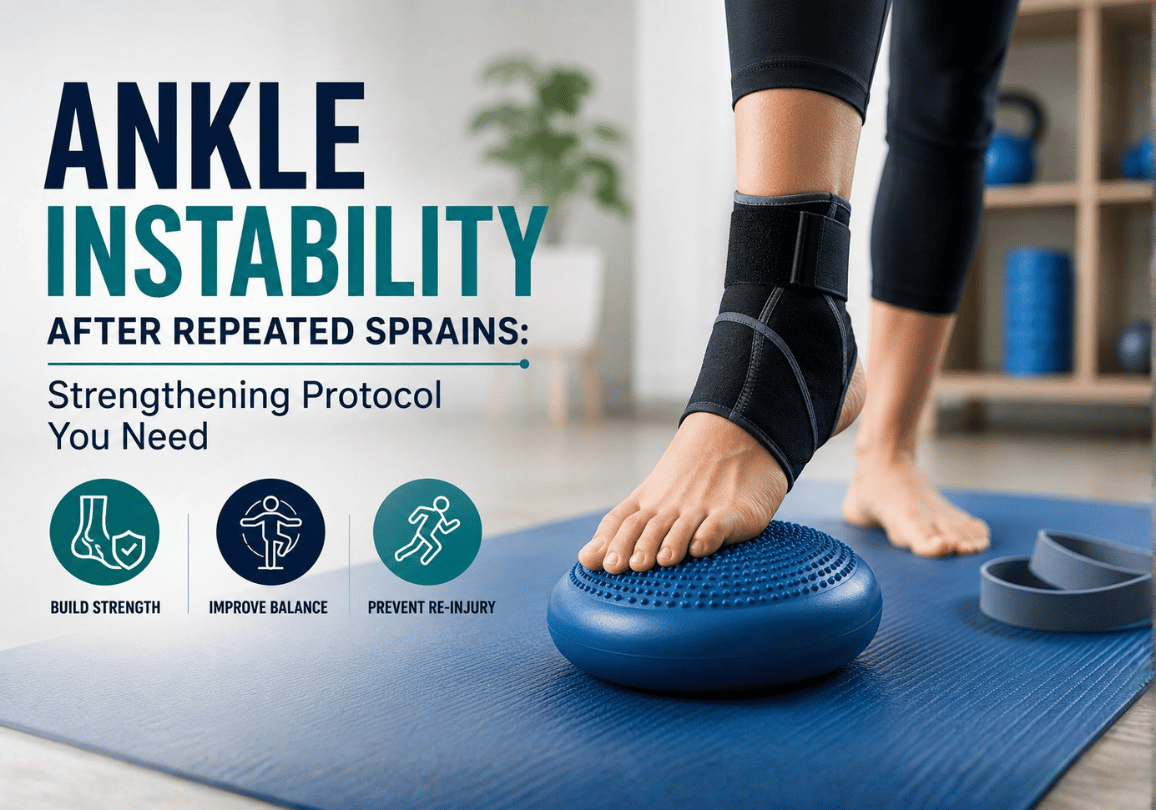
Ankle Instability After Repeated Sprains: Strengthening Protocol You Need
Chronic ankle instability is a condition that develops when an initial sprain is not adequately rehabilitated, leaving the ankle’s ligaments, muscles, and proprioceptive system in a state that makes every subsequent step on uneven ground a potential reinjury.
Ankle sprains are among the most common musculoskeletal injuries worldwide, accounting for 10 to 30% of all sports injuries, yet up to 40% of people who sustain one go on to develop persistent symptoms, including pain, instability, and recurrent sprains lasting more than 12 months.
For most people, the problem is not the severity of the original sprain but what happened afterwards. Rest, a few days off sport, and a slow return to activity without addressing the neuromuscular deficits that the injury created. The ankle feels fine until the next twist, which then feels worse because the structures protecting it were never properly rebuilt.
This article covers what causes chronic ankle instability, how lateral ankle instability is classified, and most importantly, the complete ankle sprain rehab protocol needed to restore genuine stability, along with the ankle strengthening exercises and ankle proprioception training that research shows are essential for preventing recurrence.
What Is Chronic Ankle Instability?
Chronic ankle instability is defined as repeated episodes of ankle sprains or a persistent feeling of the ankle giving way, occurring for at least 12 months following an initial ankle sprain. It is a condition characterised by structural, neuromuscular, and sensorimotor deficits that together render the ankle unable to protect itself during the rapid, reactive movements required in sport and daily life.
A systematic review published in PMC (2021) found that among people with a history of ankle sprains, the prevalence of chronic ankle instability is approximately 46%. In active sporting populations, recurrence rates in sports involving pivoting and cutting movements are even higher.
Chronic ankle instability has two overlapping components:
- Mechanical instability: Actual anatomical laxity from inadequate healing or elongation of the anterior talofibular ligament (ATFL) and calcaneofibular ligament (CFL), producing excessive joint movement beyond the physiological range.
- Functional instability: Perceived giving way and unsteadiness without measurable structural laxity, caused by deficits in proprioception, delayed peroneal muscle reaction time, and impaired neuromuscular control. This form is often missed because imaging looks normal.
Most patients with chronic ankle instability have elements of both. Treatment must address both the structural and the neuromuscular components, which is precisely what a well-designed physiotherapy programme does.
Why Ankles Keep Rolling: Anatomy of Lateral Ankle Instability
Lateral ankle instability is the most common form, accounting for 80-85% of all ankle sprains. It occurs when the foot inverts and plantarflexes suddenly, overstressing the lateral ligament complex.
After an initial sprain, microscopic tears in the ligaments can lead to attenuation and elongation. If rehabilitation does not address the neuromuscular consequences, two problems compound each other:
- Proprioceptive deficit: The ankle loses its ability to accurately sense its own position in space and respond to perturbation before a fall or re-injury can occur. Research in PMC (2024) confirms that individuals with chronic ankle instability exhibit decreased position awareness and prolonged peroneal muscle reaction times.
- Peroneal muscle weakness: The peroneal muscles are the primary dynamic stabilisers of the lateral ankle. They fire rapidly to resist inversion forces that would otherwise cause a sprain. When these muscles are weak or their reaction time is delayed, the ankle has no muscular protection against the forces that caused the original injury.
Each subsequent sprain worsens both deficits further. The ligaments become progressively laxer, and the neuromuscular system becomes increasingly unreliable. This is not a cycle that resolves with rest alone.
Repeated Ankle Sprains Treatment: What Most People Miss
Repeated ankle sprains treatment fails most commonly for one reason: the rehabilitation programme stops when pain stops. Pain and swelling resolve within days to weeks of a lateral ankle sprain. The neuromuscular deficits that drive recurrence take 6 to 12 weeks of structured training to correct. Most people discharge themselves from rehabilitation long before that work is done.
Effective repeated ankle sprains treatment requires addressing all of the following, not just pain and swelling:
- Full ligamentous healing time: Ligament tissue requires 6 to 12 weeks to mature structurally after an acute sprain. Returning to full sport loading before this window closes risks re-injury on healing tissue that has not yet regained its mechanical integrity.
- Peroneal strength restoration: Eversion strength of the affected ankle must return to within 90% of the unaffected side before sport resumption.
- Proprioceptive retraining: Joint position sense and balance on the affected ankle must be formally assessed and trained, not assumed to have resolved with pain.
- Landing and cutting mechanics: The movement patterns that caused the original sprain, typically landing with excessive inversion or cutting with the foot unsupported, must be corrected before returning to sport.
- Footwear and surface awareness: High-risk surfaces, worn footwear, and inappropriate footwear for the sport contribute significantly to recurrence.
Ankle Sprain Rehab Protocol: Phase by Phase
A structured ankle sprain rehab protocol progresses from injury protection through to full return to sport. The contemporary PEACE and LOVE framework is described in the British Journal of Sports Medicine: Protection, Elevation, Avoid anti-inflammatory modalities early, Compression, and Education in the acute phase; followed by Load, Optimism, Vascularisation, and Exercise in the recovery phase. The table below maps the full rehab continuum for lateral ankle sprain.
| Phase | Timing | Goal | Key Physiotherapy Activities |
| Phase 1
Acute |
Days 1-5 | Protect, reduce swelling, maintain mobility | PEACE and LOVE protocol is implemented. Gentle active range-of-motion. Non-weight-bearing rest as needed. |
| Phase 2
Sub-Acute |
Days 5-21 | Restore full ROM, begin weight-bearing, activate peroneals | Progressive weight-bearing. Ankle alphabet exercises. Towel scrunches. Resisted eversion with band. Gentle calf raises. Manual therapy to restore joint mobility. |
| Phase 3
Strengthening |
Weeks 3-8 | Build peroneal and calf strength, begin balance training | Resistance band eversion and dorsiflexion. Single-leg heel raises. Step-ups. Static single-leg balance. Wobble board introduction. Proprioception drills begin. |
| Phase 4
Functional |
Weeks 6-12 | Restore dynamic stability, sport-specific loading | Progressive proprioception training on unstable surfaces. Single-leg squat. Lateral hops. Agility drills. Running progression. Sport-specific cutting and landing mechanics. |
| Phase 5
Return to Sport |
Criterion-based | Full sport-specific function with no giving-way | Plyometric loading. Direction changes at speed. Reactive balance drills. Taping or bracing strategy for return. Criterion-based clearance: strength, balance, and movement quality. |
Ankle Strengthening Exercises: Building Lateral Stability
Ankle strengthening exercises for chronic ankle instability must target the peroneal muscles specifically, not just general calf and ankle bulk. The peroneus longus and brevis are the primary muscles that fire to prevent inversion. Without directly loading these in eversion, the most critical deficit is left unaddressed.
Peroneal and Eversion Strengthening
- Resisted eversion with band: Sit with the leg supported and a resistance band looped around the forefoot, anchored to a fixed point on the inner side. Move the foot outward (eversion) against the band, hold 2 seconds, return slowly. This is the most direct exercise for the peroneal muscles and forms the foundation of every lateral ankle instability programme.
- Resisted dorsiflexion: With the band anchored behind the foot, pull the toes toward the shin against resistance. Restores anterior tibialis activation, which is commonly inhibited after lateral ankle sprain and contributes to the foot-drop moment that precedes inversion injury.
- Single-leg heel raises: Stand on the affected leg and rise onto the ball of the foot slowly, hold 2 seconds at the top, lower over 3 to 4 seconds. The eccentric lowering phase is where calf and Achilles load tolerance is built. Begin with bilateral raises and progress to single-leg as strength allows.
- Step-ups with eversion emphasis: Stepping onto a low platform with the affected leg leading while maintaining a neutral subtalar position trains the peroneal muscles in a functional, weight-bearing context that directly transfers to walking and sport.
Calf and Achilles Loading
- Bilateral calf raises to single-leg progression: Begin with two-leg raises and progress to one-leg as strength and balance allow. Adequate plantar flexion strength is required before any plyometric or running rehabilitation can safely begin.
- Soleus emphasis: seated calf raise: With the knee bent at 90 degrees, rise onto the ball of the foot against resistance. The soleus is the deep calf muscle that contributes most to ankle stability during walking.
Ankle Proprioception Training: Retraining Stability from Within
Ankle proprioception training is not optional in the rehabilitation of chronic ankle instability. It is the core intervention. A systematic review published in MDPI Journal of Clinical Medicine (2025) found that balance training, proprioceptive exercises, and neuromuscular training all significantly improved dynamic balance, patient-reported outcomes, and proprioception.
A progressive ankle proprioception training programme moves through the following stages:
- Static single-leg balance: Stand on the affected leg for 30 seconds with eyes open on a firm surface. Progress to eyes closed (removing visual compensation), then on a folded mat or balance pad. This is the entry-level drill for proprioceptive retraining and should be achievable before any unstable surface work begins.
- Wobble board or balance board training: Begin with bilateral standing on a wobble board, progressing to single-leg standing and then controlled perturbations. Balance board training targets the mechanoreceptors of the ankle joint capsule and ligaments directly, rebuilding the reflex arc between position sense and peroneal muscle activation.
- Star Excursion Balance Test as a training tool: Reaching in 8 directions around a fixed centre point while standing on the affected leg assesses and trains dynamic single-leg balance simultaneously.
- Perturbation training: A physiotherapist or training partner introduces unexpected small pushes or surface tilts while the patient maintains single-leg balance.This trains the automatic, unconscious stabilisation response that prevents a sprain during sport, rather than the deliberate, controlled balance seen in standard balance drills.
- Reactive balance drills: Single-leg landing from a small hop, lateral shuffle with sudden stop, and resisted perturbation during a shallow single-leg squat train proprioception under the dynamic loading conditions that most resemble sport.
Prevent Ankle Sprains: Physiotherapy Strategies That Work Long Term
Preventing ankle sprains through physiotherapy goes beyond exercise prescription. Once the ankle has been stabilised through a structured programme, maintaining that stability requires a set of ongoing practices:
- Structured warm-up and neuromuscular activation: A 5-minute pre-activity routine including single-leg balance, lateral hops, and dynamic ankle mobilisation significantly reduces injury risk.
- Ankle bracing or taping during high-risk activity: External support with semi-rigid bracing or athletic tape reduces the ankle’s range of inversion during landing and cutting.
- Footwear and surface assessment: A physiotherapist will assess the patient’s footwear and, where needed, refer for orthotics to address hindfoot varus or other structural factors that predispose to inversion.
- Maintenance proprioception training: A short daily or pre-session balance routine maintains the neuromuscular competence built during formal rehabilitation.
- Education and body awareness: Understanding which surfaces, movements, and fatigue states increase sprain risk allows athletes to make smarter decisions. Recognising signals from the body and adjusting intensity or using support accordingly is a learnable protective behaviour.
Key Takeaways
- Chronic ankle instability affects approximately 46% of people with a history of ankle sprain. It is driven by inadequate rehabilitation after the initial injury.
- Most recurrences occur because rehabilitation stops when pain resolves, before proprioceptive and strength deficits are corrected.
- Repeated ankle sprains treatment must address ligamentous healing time, peroneal eversion strength, proprioceptive retraining, landing mechanics, and footwear, not just pain and swelling.
- Ankle strengthening exercises for chronic instability must specifically target peroneal eversion, dorsiflexion, and progressive single-leg calf loading. General ankle exercises are insufficient without directly loading the muscles that resist inversion.
- Ankle proprioception training is confirmed as essential for restoring the neuromuscular competence that prevents re-injury.
- To prevent ankle sprains, physiotherapy recommends structured neuromuscular warm-ups, ankle bracing or taping during return to sport, appropriate footwear, and a maintenance balance routine maintained long after formal rehabilitation ends.
Frequently Asked Questions
Q1. Why does my ankle keep rolling even after it has healed?
The ankle feels healed when pain and swelling are gone, but the proprioceptive and strength deficits that make re-injury likely remain. Research shows that peroneal muscle reaction time and joint position sense are both impaired after a lateral ankle sprain and do not recover without specific rehabilitation. Pain resolution is not the same as structural and neuromuscular recovery.
Q2. Can chronic ankle instability be fixed without surgery?
Yes, for most patients. Conservative management with a structured ankle sprain rehab protocol, including peroneal strengthening, ankle proprioception training, and neuromuscular retraining, is the first-line treatment for chronic ankle instability and succeeds in the majority of cases. Surgery is considered for mechanical instability that fails to respond to 6 months of structured physiotherapy, or for patients with confirmed severe ligamentous laxity requiring anatomical reconstruction.
Q3. How long does rehab for chronic ankle instability take?
A structured programme typically takes 8 to 12 weeks to complete all phases, including return-to-sport clearance, for mild to moderate instability. More severe cases, or those involving a concurrent injury such as an ACL tear, take longer. The most important point is that return to sport must be criterion-based, not time-based. Strength symmetry, proprioception, and movement quality must all meet defined standards before clearance is given.
Q4. Are ankle-strengthening exercises enough to prevent re-injury?
No, not alone. Ankle strengthening exercises are essential, but must be combined with ankle proprioception training to address the neuromuscular deficits that make re-injury likely. Strengthening is more effective than balance training for joint position sense, while balance training has stronger effects on dynamic balance. Combining both approaches produces the most comprehensive protection against recurrence.
Q5. Should I tape or brace my ankle to prevent ankle sprains?
Yes, during high-risk activity in the first 6 to 12 months after a significant lateral ankle sprain. External support through semi-rigid bracing or athletic taping reduces the range of ankle inversion available during landing and cutting, thereby reducing re-injury risk during the period when neuromuscular competence is still being rebuilt. It is not a substitute for rehabilitation but a sensible adjunct during that rebuilding phase.
Q6. Can I run on a sprained ankle?
No, not during the acute phase. Running resumes only once the ankle can tolerate full pain-free weight-bearing, strength is being progressively rebuilt, and dynamic balance on the affected leg is confirmed by your physiotherapist. Running too early on a structurally compromised ankle with unresolved proprioceptive deficits is one of the most common ways the original sprain becomes chronic instability.
Q7. Does Healyos provide ankle instability physiotherapy and chronic ankle instability treatment in Pune?
Yes, Healyos provides dedicated physiotherapy for chronic ankle instability, lateral ankle instability, and recurrent ankle sprains in Pune through home visits, in-clinic sessions, and online consultations. Our Pune-based sports and orthopaedic physiotherapists assess the full picture of ankle instability, including strength deficits, proprioceptive function, movement mechanics, and footwear, before designing an individually sequenced rehabilitation programme. You can book an online consultation to arrange an ankle assessment.

Leave a Reply