
Healyos Physiotherapy Journal · Neuro Physiotherapy
A guide for families on what rehab involves, what progress looks like, and how home-based care can support it.
After a stroke, the hospital stay is only the beginning. The brain has a remarkable ability to rewire itself, known as neuroplasticity, and physiotherapy is one of the main ways to guide that rewiring towards regaining movement, balance, and independence.
A stroke occurs when blood supply to part of the brain is blocked or when a blood vessel bursts. Brain cells in that area are damaged, and the abilities they controlled, such as moving an arm or leg, balancing, or speaking, can be affected. Because the brain controls the opposite side of the body, weakness usually appears on one side.
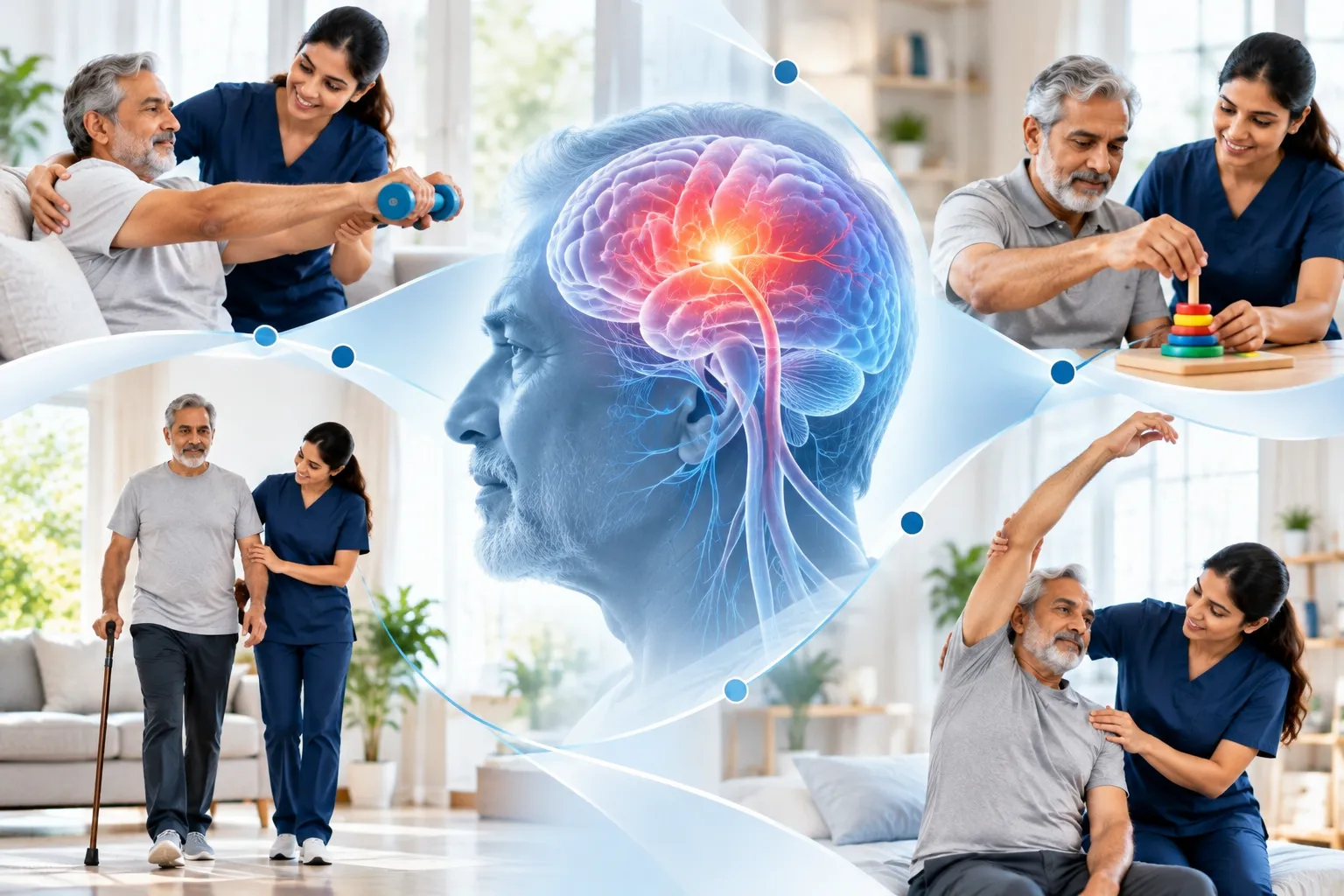
Recovery looks different for every person, depending on the part of the brain affected, the severity of the stroke, and how soon rehabilitation begins. Rehab is usually started as early as the treating doctor considers it safe. The table below outlines the common challenges after a stroke and the physiotherapy approaches used to address them.
| Area | Common Challenge | Physiotherapy Approach |
|---|---|---|
| Muscle weakness | Weakness or paralysis on one side of the body | Repetitive, task-focused strengthening and active movement practice |
| Balance and walking | Unsteady standing, difficulty with gait, higher fall risk | Balance training, gait re-training, and safe transfers, with aids when needed |
| Muscle tightness | Stiff, tight muscles (spasticity) that limit movement | Stretching, positioning, and guided exercise, coordinated with the treating doctor |
| Shoulder and arm | Pain or poor control of the affected shoulder and hand | Correct positioning and handling, and graded arm and hand exercises |
| Fatigue and endurance | Tiring quickly, reduced stamina | Gradual endurance building with rest built into the plan |
| Daily activities | Difficulty with sitting up, standing, dressing, or moving around the home | Practising real daily tasks at home, plus caregiver training |
Small, repeated efforts each day build the pathways that lead back to independence.
The brain is most responsive to relearning in the weeks and months after a stroke. Repeated, purposeful practice of movement during this window helps strengthen the pathways that remain and build new ones.
Early rehabilitation also helps prevent complications that can follow prolonged inactivity, including muscle shortening and joint stiffness, pressure sores, chest infections, blood clots in the legs, and shoulder problems on the weak side.
Starting rehab does not mean pushing hard. It begins when your doctor confirms you are medically stable, with simple movements such as positioning, turning in bed, and sitting up. Intensity builds as strength and tolerance grow.
Regain movement and strength in the affected arm and leg.
Improve balance and walking, reducing the risk of falls.
Learn safe ways to move in and out of bed, on and off a chair, and around the home.
Prevent secondary problems such as stiffness, contractures, pressure sores, and shoulder pain.
Build independence in daily life, from dressing and bathing to getting to the toilet, so the person can do as much as possible themselves.
Support the caregiver, through training on safe handling and a clear home programme.
Task-specific training. Practising real activities, such as standing up, reaching for a cup, or walking, is more effective than isolated exercises alone, because the brain learns by repeating meaningful tasks.
Strengthening and repetition. Progressive exercise, with the right level of challenge, retrains weakened muscles and improves control.
Balance and gait training. This includes weight shifting, standing practice, stepping, and walking, with support or aids as needed, progressing as confidence grows.
Positioning and handling. Correct support of the weak arm and leg in bed and chair protects the joints and reduces pain and stiffness.
Stretching and tone management. For tight, spastic muscles, regular stretching and positioning are used alongside any medical treatment your doctor recommends.
The approach is always individual. A plan for someone who can already walk with support looks very different from one for someone who is just learning to sit unsupported.
Clear the paths. Remove loose rugs, cables, and clutter. Keep walkways wide enough for a walker or wheelchair if one is needed.
Make the bathroom safer. Non-slip mats, grab bars, a shower stool, and a commode chair or raised toilet seat can greatly reduce the risk of falls.
Choose supportive furniture. A firm chair with armrests and a bed at a suitable height make transfers easier and safer.
Light the way. Night lights between the bedroom and the bathroom help prevent night-time falls.
Arrange the space. Keep commonly used items within easy reach and in view, and avoid placing important things only on the weak side where they may be missed.
Never pull on the weak arm. Lifting or pulling a person by the affected arm can injure the shoulder. Your physiotherapist will teach safe ways to help with transfers.
Encourage independence. It is tempting to do everything for someone who is struggling, but letting them do what they safely can speeds recovery and rebuilds confidence.
Keep a routine. Regular times for exercise, meals, and rest help recovery, and short sessions spread through the day are often more tolerable than one long session.
Change position regularly. For people who spend long periods in bed, changing position about every two hours, or as advised, helps protect the skin and joints.
Look after yourself. Caregiving is demanding. Taking breaks, sharing responsibility with family, and accepting support protect your own health, which in turn protects the patient's.
Follow the medical plan. Medicines, blood pressure and blood sugar control, and follow-ups with the doctor are essential for reducing the risk of another stroke.
Fatigue, mood changes, and frustration are common after a stroke. Rest, emotional support, and a steady routine matter as much as the exercises themselves.
Progress often comes in steps rather than a straight line, with periods that feel stuck followed by sudden gains. Many people continue to improve well beyond the first few months with ongoing therapy.
Treat these signs as an emergency: sudden face drooping, arm or leg weakness, slurred or confused speech, severe sudden headache, or loss of vision. A new stroke needs immediate hospital care, so call 112 or reach the nearest hospital without delay.
Myth: Recovery stops after the first six months. Most improvement occurs early, but gains can continue for much longer with consistent, well-designed therapy.
Myth: The patient should rest until they feel stronger. Rest is important, but too much of it leads to weakness and stiffness. Guided activity, started when medically safe, supports recovery.
Myth: Good rehab is only possible in a hospital or centre. Practising in the home, where the real daily tasks happen, can make therapy more relevant. Families also learn how to support safe movement between sessions.
Myth: Massage alone will restore movement. Massage may feel comforting, but regaining function depends on the brain relearning through active, repeated movement.
Healyos was established in 2015 under the guidance of Padma Vibhushan Dr. K.H. Sancheti, and our approach is built on accurate diagnosis, personalised care, and lasting recovery. Every plan follows the same five steps:
1. Initial consultation and assessment. We review the medical history, the doctor's instructions, the person's current abilities, and the home setup, and we speak with the family about their goals.
2. Accurate diagnosis. A detailed neurological and movement assessment looks at strength, tone, balance, walking, and daily function, to set the starting point.
3. Personalised treatment phase. A personalised plan combines strengthening, balance and walking practice, task-based training, and safe handling, all matched to what the person can do now.
4. Progress monitoring and adjustments. Progress is measured regularly, and the plan is advanced or modified as abilities change, in coordination with the treating doctor.
5. Post-treatment care and prevention. The family receives a clear home programme, and guidance on fall prevention and on keeping the gains made.
Sessions typically last 45 to 60 minutes, and you can choose physiotherapy at home across Pune, in-clinic sessions, or online consultations for guided follow-ups.
How soon after a stroke should physiotherapy start?
As soon as the treating doctor confirms the person is medically stable, which is often within the first days in hospital. Starting early, at a gentle level, supports better recovery.
How long will rehabilitation take?
There is no fixed timeline. Many people make the fastest gains in the first few months, and improvement can continue with ongoing practice. Your physiotherapist will set goals and review them as you progress.
Can home physiotherapy replace hospital rehabilitation?
Home physiotherapy is a valuable way to continue and extend rehabilitation after discharge. It works best alongside regular follow-up with the treating doctor and, where needed, speech and occupational therapy.
What if the person has difficulty speaking or swallowing?
These are separate problems that need assessment by a speech-language therapist. Your physiotherapist can help coordinate with the doctor and other therapists.
How can we reduce the risk of another stroke?
Take medicines exactly as prescribed, keep blood pressure, blood sugar, and cholesterol under control, avoid tobacco, stay active as advised, and attend all follow-ups.
Compassionate neuro rehab at home
Healyos physiotherapists provide neurological rehabilitation at home across Pune, with personalised plans, progress tracking, and practical guidance for caregivers.
Or call us on +91 93256 09388
This article is for general education and is not a substitute for a medical diagnosis. Please consult a qualified doctor or physiotherapist about your own condition.