
Healyos Physiotherapy Journal · Post-Operative Rehab
What the weeks after surgery typically look like, and how physiotherapy shapes each stage.
A knee replacement fixes the joint, but physiotherapy is what makes the new knee work. Surgeons often say that the operation is only half of the result, and the rehabilitation that follows is the other half. Patients who start moving early and follow their exercise plan consistently tend to regain bending, strength, and confidence sooner.
Knee replacement surgery is usually recommended when arthritis or damage has worn away the joint surface, causing pain that limits walking, climbing stairs, sleeping, and everyday life. The surgery removes the damaged surfaces and replaces them with an artificial joint. But the muscles around the knee, which have often been weak for years because of pain, still need to be retrained.
Many people worry about the pain of those first exercises and the long road ahead. Understanding what is normal at each stage, and what your physiotherapist is trying to achieve, makes the process far less daunting.
The roadmap below shows how recovery typically progresses. Treat it as an orientation, not a prescription. Your surgeon's protocol and your physiotherapist's assessment come first, because timelines differ with age, fitness, the type of surgery, and other health conditions.
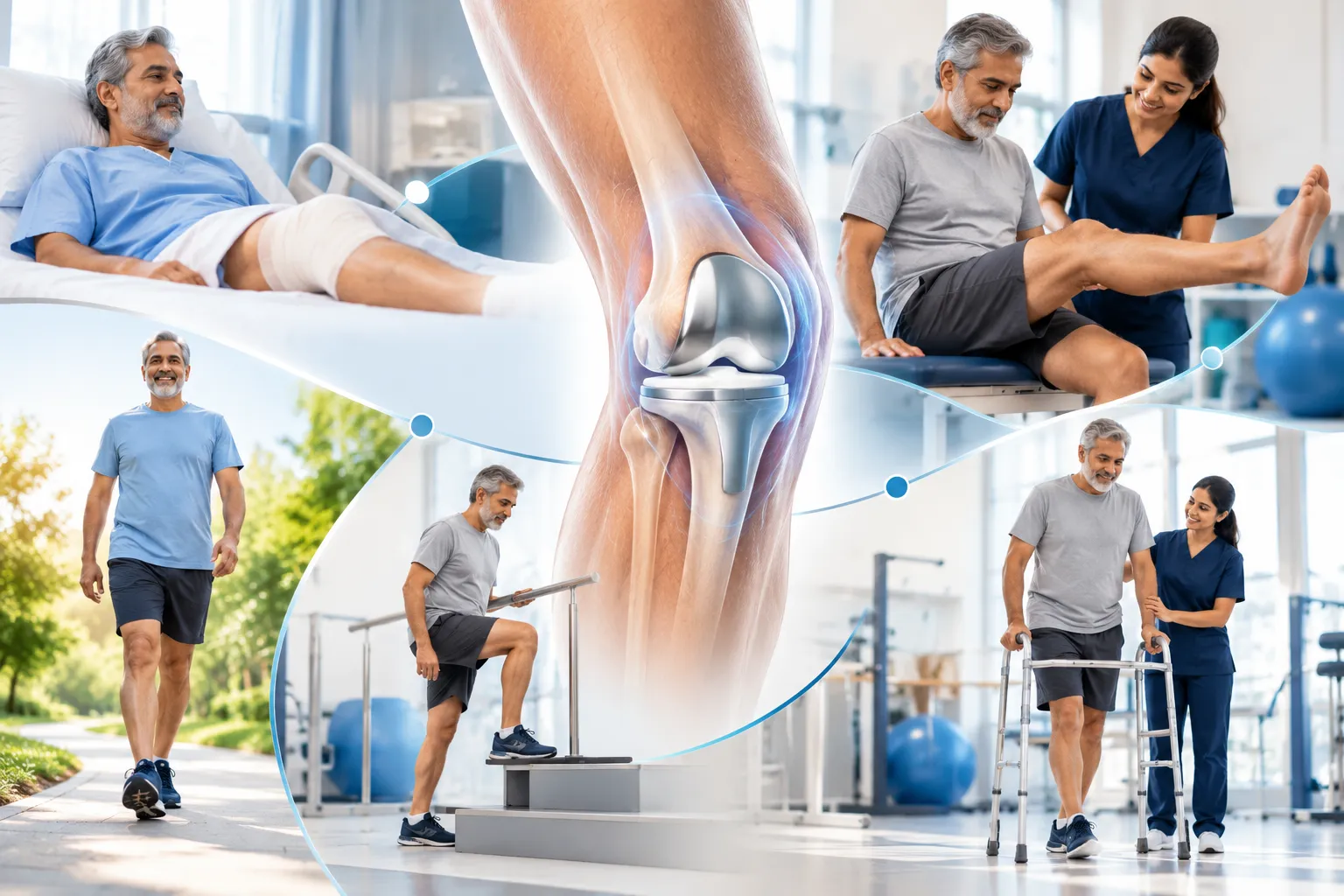
| Stage | Main Focus | Typical Goals |
|---|---|---|
| Day 0 to 2 (hospital) | Early movement, circulation, and pain control | Ankle pumps, gentle quadriceps activation, first assisted standing and steps with a walker |
| Weeks 1 to 2 | Swelling control and regaining basic motion | Walking with support, steadily improving knee bend, working towards full straightening |
| Weeks 2 to 6 | Range of motion and early strengthening | Improved bending, stronger thigh muscles, managing stairs with support |
| Weeks 6 to 12 | Strength, balance, and walking pattern | Reducing reliance on walking aids, better balance, longer walks |
| 3 to 6 months | Return to everyday life and activity | Getting up from the floor safely, longer walks, low-impact activity such as cycling as advised |
| Up to 12 months | Continued gains and long-term protection | Strength and function keep improving; a maintenance routine protects the new joint |
The pain of the first exercises is temporary. A stiff knee that was never rehabilitated is not.
Recovery begins before the operation. Strengthening the thigh and hip muscles in the weeks before surgery, where your surgeon agrees, gives you a stronger starting point. Many physiotherapists also teach patients how to use a walker or crutches before surgery, so it is familiar by the time it is needed.
Knowing what is coming reduces anxiety, too. A pre-surgery session that explains the first exercises, how you will get in and out of bed, and what the first week at home looks like can make a real difference to confidence.
If you have time, set up your home in advance. Arrange a comfortable chair with armrests, keep frequently used items within easy reach, and clear pathways, so you aren't preparing the house while recovering.
Range of motion work. Gently increasing how far the knee bends and straightens is a priority, because stiffness is easier to prevent than to treat later.
Strengthening. The quadriceps, hamstrings, glutes, and calf muscles are rebuilt step by step, starting with simple activation exercises and progressing to standing and walking-based work.
Swelling management. Elevation, positioning, and, where advised, cold therapy help control swelling, which otherwise limits movement and slows progress.
Walking and gait re-training. Your physiotherapist works on putting weight evenly through both legs, walking with a smooth pattern, and progressing from a walker to a stick and then to independent walking when safe.
Balance and function. Later stages focus on stairs, getting up from low seats, and the balance needed for everyday movement. This is also the stage where scar tissue mobility may be addressed once the wound has healed.
These exercises appear in many post-knee-replacement programmes. They are listed for understanding, and your surgeon and physiotherapist will decide what you should do, when, and how many.
Ankle pumps: moving the foot up and down while lying down. This helps circulation and reduces the risk of clots and swelling.
Quadriceps sets: tightening the thigh muscle by pressing the back of the knee down towards the bed, then relaxing.
Heel slides: lying on your back and sliding the heel towards the buttock to gently increase knee bend.
Straight leg raises: once approved, lifting the straightened leg a short distance to strengthen the thigh without bending the knee.
Seated knee extension: sitting in a chair and slowly straightening the knee to build strength in the front of the thigh.
Sit-to-stand practice: rising from a stable chair with control, which turns strength into real-life function.
Remove trip hazards. Loose rugs, trailing wires, and clutter increase the risk of falls. Use night lights on the way to the bathroom.
Use a supportive chair. A firm chair with armrests makes standing up easier, and a raised cushion can help if the seat is too low.
Think about the bathroom. Many homes in India have low or squat-style toilets and floor-level bathing. Ask your surgeon and physiotherapist what is safe for you. A raised toilet seat, a commode chair, a stool for bathing, and non-slip mats are common solutions.
Sitting on the floor and cross-legged. Many patients want to return to floor seating for prayer or family meals. How deeply the knee can safely bend varies with the implant and the individual, so ask your surgeon before attempting this.
Keep essentials close. Water, medicines, phone, and walking aid within reach reduces unnecessary movement and risk.
Pain. Some pain after surgery is expected, and it is usually worse at the start of a new exercise. Taking prescribed pain medicine as advised before therapy sessions can make movement easier. Tell your physiotherapist if pain is increasing instead of gradually reducing.
Sleep. Many people sleep poorly in the first weeks. Pillows to support the leg, avoiding a pillow directly under the knee for long periods if advised, and keeping a regular routine can help.
Swelling. Swelling often rises through the day and eases overnight. Elevating the leg, walking in short regular bouts, and following the guidance on cold therapy usually keep it manageable.
Swelling, warmth, bruising, and stiffness in the operated knee are expected for weeks, and swelling often feels worse at the end of the day. Elevation, prescribed medicines, and regular movement are the usual way to manage this.
Clicking sensations, or numbness near the scar, are also common and generally settle with time.
What isn't normal and needs a prompt call to your surgeon: fever, increasing redness or discharge from the wound, severe new calf pain or swelling, or sudden inability to bear weight. Chest pain or breathlessness is an emergency, so go to the nearest hospital immediately.
Myth: I should rest until the pain is gone before exercising. Early, guided movement is a core part of recovery. Waiting too long allows stiffness and scar tissue to build up, which becomes harder to reverse.
Myth: More exercise, faster, means quicker recovery. Overdoing it can increase swelling and set you back. A good plan builds load progressively and respects the healing timeline.
Myth: Rehab is only necessary in the first few weeks. The biggest gains in strength and function often come over the following months, which is why continued physiotherapy and a home exercise routine matter.
Myth: A new knee lasts forever, so I can do anything. Artificial joints can last many years, but strength, a healthy weight, and sensible activity choices help protect them.
Healyos was established in 2015 under the guidance of Padma Vibhushan Dr. K.H. Sancheti, and our approach is built on accurate diagnosis, personalised care, and lasting recovery. Every plan follows the same five steps:
1. Initial consultation and assessment. We review your surgery details, your surgeon's instructions, your home layout, and your goals, such as walking, climbing stairs, or returning to prayer and daily routines.
2. Accurate diagnosis. Assessment of knee range, swelling, strength, balance, and walking pattern gives a baseline against which progress is measured.
3. Personalised treatment phase. A progressive plan of range-of-motion, strengthening, gait, and balance work, delivered at home so you can recover in a comfortable, familiar environment.
4. Progress monitoring and adjustments. Measurements and goals are reviewed regularly, and the programme is adjusted as your knee improves, always within your surgeon's guidance.
5. Post-treatment care and prevention. A long-term exercise routine and guidance on activities that protect your new joint.
Sessions typically last 45 to 60 minutes, and you can choose physiotherapy at home across Pune, in-clinic sessions, or online consultations for guided follow-ups.
When can I climb stairs?
Many people begin practising stairs with support within the first couple of weeks, but the timing depends on your surgery and strength. Your physiotherapist will teach the safe technique and tell you when to progress.
When can I drive again?
This depends on which knee was operated on, whether your car is automatic or manual, your reaction time, and your surgeon's advice. Check with your surgeon before returning to driving.
How many physiotherapy sessions will I need?
It varies, but rehabilitation usually spans several weeks to a few months, with exercise continuing at home afterwards. Your physiotherapist will plan this around your progress.
Is physiotherapy at home as effective as in a clinic?
For most patients, yes, as long as the programme is structured and supervised. Home visits also mean your physiotherapist can see your real environment, such as your bed, stairs, and bathroom, and plan around them.
What if my knee isn't bending as much as I expected?
Bending usually improves gradually, and it can plateau for a while. Let your physiotherapist and surgeon know early, because stiffness is far easier to address in the first weeks than months later.
Post-surgery rehab at your doorstep
Travelling in the weeks after surgery is tiring. Healyos brings certified physiotherapists, proper equipment, and a progressive plan to your home anywhere across Pune.
Or call us on +91 93256 09388
This article is for general education and is not a substitute for a medical diagnosis. Please consult a qualified doctor or physiotherapist about your own condition.