

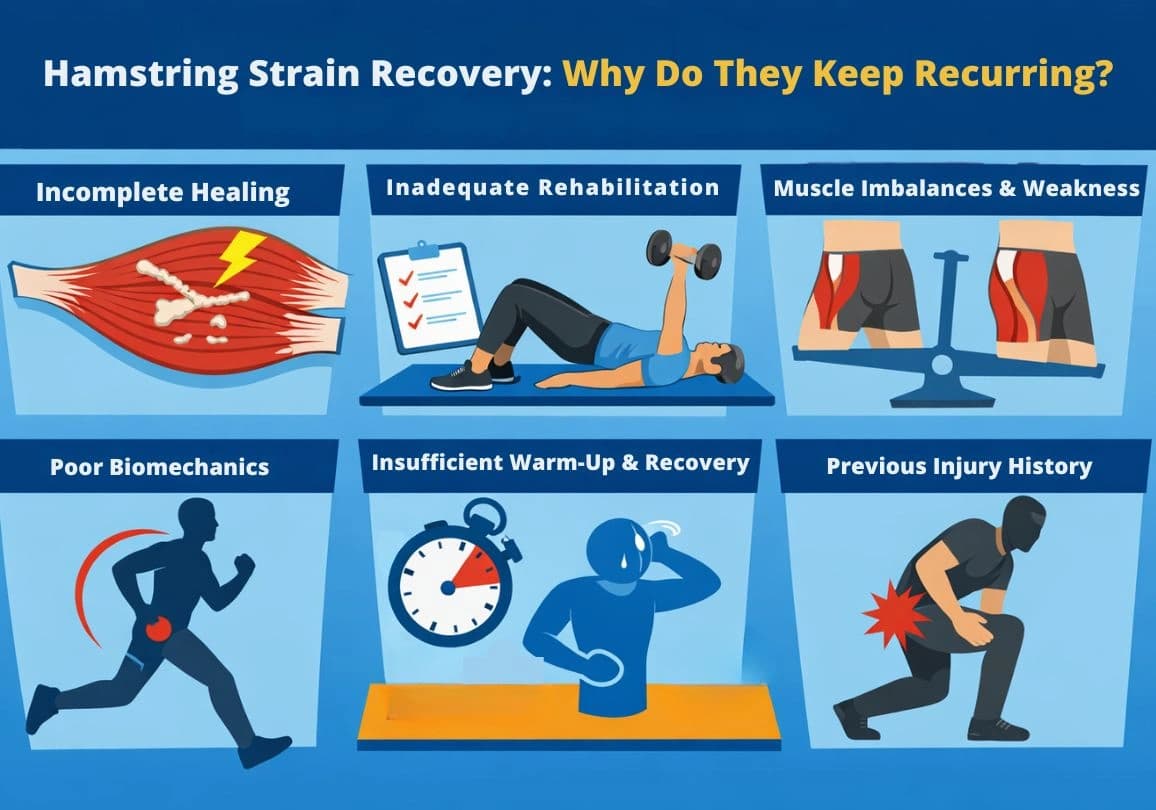
If you’ve experienced a hamstring strain, you’re likely familiar with the frustrating cycle of recovery, return to activity, and re-injury. Hamstring strains keep recurring primarily due to incomplete healing, inadequate rehabilitation, premature return to activity, muscle imbalances, and poor biomechanics. The good news? Understanding why these injuries come back is the first step toward breaking the cycle and achieving lasting recovery.
At Healyos Physiotherapy in Pune, we’ve helped countless patients overcome recurrent hamstring injuries through evidence-based treatment and comprehensive rehabilitation programs—whether you visit our clinic or prefer the convenience of at-home physiotherapy services.
Your hamstring is actually a group of three muscles running along the back of your thigh: the biceps femoris, semitendinosus, and semimembranosus. These muscles work together to bend your knee and extend your hip—movements essential for walking, running, jumping, and virtually every lower body activity.
A hamstring strain occurs when one or more of these muscles are overstretched or torn. This commonly happens during activities involving:
The severity ranges from Grade 1 (mild strain with minimal muscle fiber damage) to Grade 3 (complete muscle tear). While any grade can recur, Grade 1 and 2 strains are particularly prone to re-injury when not properly rehabilitated.
The most critical factor in recurrent hamstring strains is returning to activity before the muscle has fully healed. While pain may subside within a few weeks, complete tissue healing and remodeling can take 6-12 weeks or longer.
Scar tissue that forms during healing is initially weaker than healthy muscle tissue. If you resume high-intensity activities too soon, this vulnerable tissue becomes a prime site for re-injury. Many athletes feel “good enough” and rush back to sport, only to re-tear the same area within weeks.
Hamstring injury rehabilitation isn’t just about rest—it requires a progressive, structured approach. Unfortunately, many people stop their recovery program once pain disappears, missing crucial strengthening and functional training phases.
Proper rehabilitation should include:
Hamstring weakness compared to your quadriceps (the muscles on the front of your thigh) creates a significant risk factor for both initial and recurrent strains. Ideally, your hamstring strength should be at least 60% of your quadriceps strength—a ratio often disrupted after injury.
Additionally, weakness in your glutes, core, or opposite leg can force your hamstrings to compensate, increasing strain and injury risk.
How you move matters tremendously. Poor running mechanics, excessive anterior pelvic tilt, limited hip mobility, or compensatory movement patterns developed during initial injury can all perpetuate the injury cycle.
Jumping into intense activity with cold muscles or training when fatigued significantly increases hamstring strain risk. Similarly, inadequate recovery between training sessions doesn’t give muscles time to adapt and strengthen.
Perhaps the most sobering statistic: if you’ve had a hamstring strain before, you’re 2-6 times more likely to experience another one. This highlights the critical importance of comprehensive rehabilitation and ongoing preventive strategies.
Immediately following a hamstring injury, focus on:
Once acute pain subsides, begin:
Our Healyos physiotherapists can guide you through this phase either at our Pune clinic or through personalized home visits, ensuring you progress safely.
This crucial phase focuses on rebuilding strength and resilience:
Eccentric exercises are gold-standard for hamstring rehabilitation. The Nordic hamstring curl, for example, has been shown to reduce re-injury rates by up to 51%. This exercise involves slowly lowering yourself forward while kneeling, controlling the descent with your hamstrings.
Other key exercises include:
Progression should be gradual, guided by pain levels and functional capacity rather than arbitrary timelines.
Before returning to sport or high-level activity, you should achieve:
Our team at Healyos uses objective testing criteria to determine when you’re truly ready for full return, minimizing re-injury risk.
Continue hamstring strengthening exercises even after full recovery. Nordic curls, deadlift variations, and eccentric training should become permanent fixtures in your routine—aim for 2-3 times weekly.
A thorough warm-up increases muscle temperature, improves elasticity, and prepares your nervous system. Include:
While excessive stretching won’t prevent injuries, maintaining adequate flexibility in your hamstrings, hip flexors, and calves supports optimal movement patterns. Balance flexibility work with strengthening for best results.
Working with a physiotherapist to identify and correct movement dysfunction can dramatically reduce re-injury risk. At Healyos, we use video gait analysis and functional movement screening to pinpoint problems and develop corrective strategies.
Pay attention to warning signs like unusual tightness, mild discomfort, or fatigue. These may indicate you’re pushing too hard. Adjust training load accordingly and incorporate adequate rest days.
Expert guidance makes a significant difference. Whether through clinic visits or our convenient at-home physiotherapy services in Pune, Healyos provides:
Consult a physiotherapist if you experience:
Q: How long should I wait before running again after a hamstring strain?
The timeline varies based on injury severity, but typically ranges from 3-6 weeks for Grade 1 strains to 12+ weeks for Grade 2 strains. However, time alone isn’t the determining factor—you should demonstrate pain-free strength, flexibility, and successfully complete functional tests like single-leg hops and progressive running drills before returning to full-speed running. A physiotherapist can assess your readiness objectively.
Q: Can I prevent hamstring strains if I’ve never had one before?
Absolutely! Incorporating Nordic hamstring curls 2-3 times weekly, maintaining balanced quadriceps-to-hamstring strength ratios, ensuring proper warm-up routines, and addressing any flexibility limitations or biomechanical issues can significantly reduce your initial injury risk. Athletes who engage in high-speed running, kicking, or jumping benefit most from preventive programs.
Q: Are certain people more prone to hamstring strains than others?
Yes. Risk factors include previous hamstring injury (the strongest predictor), older age, hamstring weakness or tightness, poor core stability, inadequate warm-up practices, muscle fatigue, and certain sports like football, soccer, track and field, and dance. Additionally, individuals with hamstring-to-quadriceps strength ratios below 60% face increased risk.
Q: What’s the difference between hamstring tendinopathy and a hamstring strain?
A hamstring strain is an acute injury involving muscle fiber tearing, typically occurring suddenly during activity with immediate pain. Hamstring tendinopathy is a chronic overuse condition affecting the tendon (where muscle attaches to bone), developing gradually with pain that worsens during and after activity. While strains heal with appropriate rest and rehabilitation in weeks to months, tendinopathy often requires longer management including load modification and specific tendon-loading exercises.
Q: Should I use heat or ice for a recurrent hamstring injury?
In the first 48-72 hours after acute injury or re-injury, ice is recommended to reduce inflammation and pain (15-20 minutes every 2-3 hours). After this acute phase, heat may be more beneficial before activity to improve blood flow and muscle elasticity, while ice can still help post-activity to manage any inflammation. For chronic hamstring pain without acute injury, heat is generally preferred. However, use what provides relief—individual responses vary.