

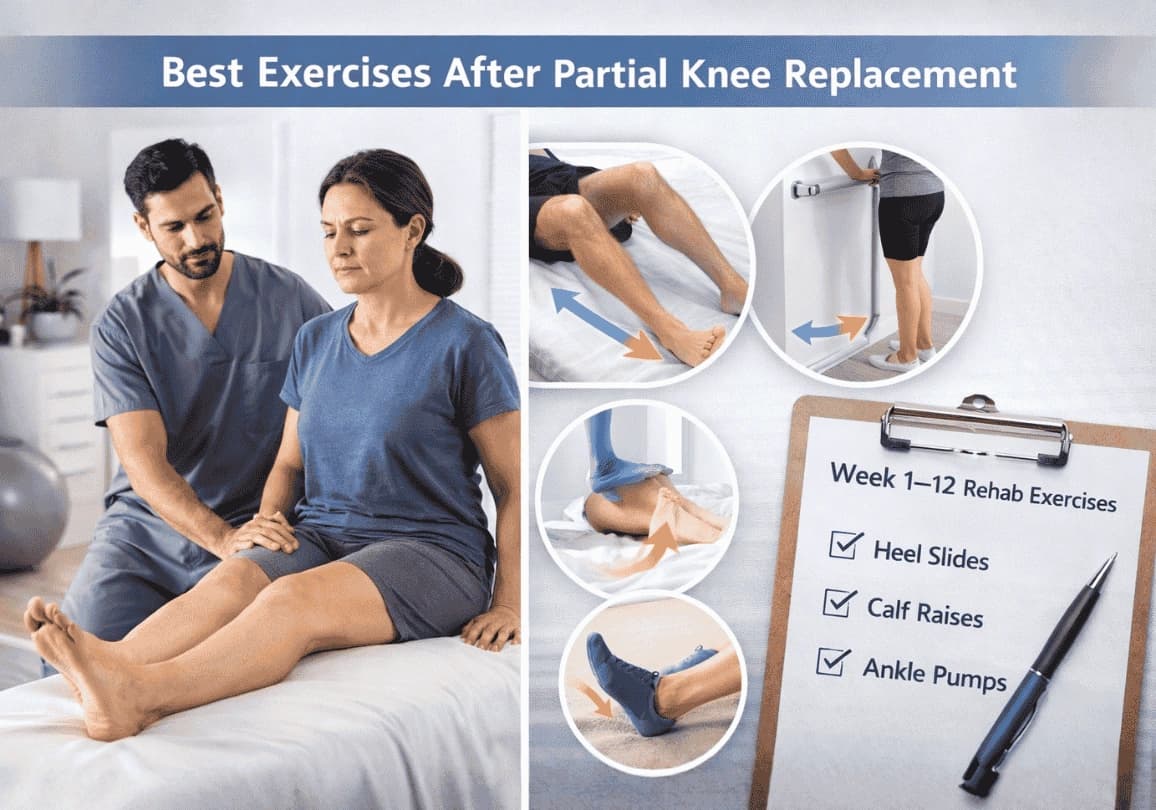
If you’ve recently had a partial knee replacement, you’re probably wondering — when can I start moving, and what exercises are safe? The short answer: the right exercises after partial knee replacement begin as early as Day 1 post-surgery, starting with gentle movements like ankle pumps and quad sets, and progressing to strengthening and walking exercises over the following weeks. Starting early and staying consistent is what separates a smooth recovery from a prolonged one.
At Healyos Physiotherapy, Pune, we guide patients through every phase of knee replacement recovery — both at our clinic and through personalised home visit sessions.
A partial knee replacement (also called a unicompartmental knee replacement) replaces only the damaged portion of the knee joint. Because less bone and tissue is involved compared to a total knee replacement, recovery tends to be faster — but that doesn’t mean you can skip rehabilitation.
Without a structured exercise programme, you risk:
Structured partial knee replacement rehab exercises are the single most important factor in getting back to your normal life quickly and safely.
The first week focuses on reducing swelling, preventing blood clots, and gently waking up the muscles without stressing the new joint.
Move your foot up and down repeatedly, as if pressing a car pedal. This simple movement improves blood circulation and is one of the first exercises after partial knee replacement surgery recommended by physiotherapists.
Tighten your thigh muscle by pressing the back of your knee gently into the bed. Hold for 5 seconds, then release.
Tighten your quad, then raise your leg to approximately 45 degrees while keeping it straight. Hold for 2–3 seconds, then lower slowly.
Lying flat, slowly slide your heel towards your buttocks, bending the knee gently. Hold briefly, then slide back.
Swelling should be reducing, and most patients are walking short distances with a support aid by now. The focus shifts to increasing range of motion and building muscle strength.
Sit in a firm chair and slowly straighten your leg until fully extended. Hold for 3 seconds, then lower.
Place a rolled towel under your knee and extend your leg from a 45-degree bend to full extension. This is one of the most effective exercises after partial knee replacement for isolated quad strengthening.
Hold a sturdy support, gently bend your knee behind you, and hold for 3–5 seconds. This improves active knee flexion in a functional, weight-bearing position.
Stand holding a support, rise up onto your toes slowly, then lower. Strengthens the calf and improves ankle stability.
By this phase, most patients have reduced or eliminated their walking aid. The goal now is to build functional strength, improve balance, and prepare for a full return to daily activities.
Stand with feet shoulder-width apart, holding a support lightly. Bend your knees slightly — no deeper than 30 to 45 degrees — then stand back up.
Using a low step (start with 5–10 cm), step up with your operated leg leading, then step down in a controlled manner.
Lie on your non-operated side and raise your operated leg to about 45 degrees, keeping it straight. Hold for 2 seconds, then lower.
Stand on your operated leg for 10–30 seconds, holding a support lightly only if needed. Progress to doing this without support as confidence grows.
Benefit: Restores proprioception (joint position awareness) — often overlooked but critical for long-term knee stability
Most patients are cleared for more active partial knee replacement rehab exercises by 8–12 weeks, subject to their surgeon’s guidance.
Appropriate activities at this stage include:
Activities to avoid until cleared by your surgeon include running, jumping, squatting deeply, and high-impact sports.
Getting the exercises right is only part of the equation. Here are some additional tips our Healyos physiotherapists recommend:
At Healyos Physiotherapy in Pune, we specialise in post-surgical knee rehabilitation. Whether you prefer to visit our clinic or recover from the comfort of your home, our experienced physiotherapists design personalised recovery plans tailored to your surgery, fitness level, and goals.
Our services include:
Q1. How soon can I walk normally after a partial knee replacement?
Most patients walk with a frame or crutches within 24 hours of surgery. Walking without support typically becomes comfortable between 3–6 weeks, depending on individual progress and adherence to physiotherapy.
Q2. Is it normal for my knee to still swell weeks after surgery?
Yes, some swelling can persist for 3–6 months after a partial knee replacement. This is normal and gradually reduces with consistent exercise, icing, and elevation. Sudden increases in swelling, however, should be reported to your surgeon.
Q3. Can I do these exercises at home without a physiotherapist?
While the exercises listed here are generally safe, having a physiotherapist assess your technique — at least in the early weeks — helps prevent compensation patterns and ensures you’re progressing correctly. Healyos offers home visit physiotherapy in Pune for exactly this reason.
Q4. When can I drive again after a partial knee replacement?
Most patients can return to driving between 4–6 weeks post-surgery, but this depends on which leg was operated on and your surgeon’s clearance. Never drive while still taking strong pain medication.
Q5. Will I need physiotherapy even if I feel fine after surgery?
Yes. Feeling okay is not the same as the knee being fully rehabilitated. Muscle strength, balance, and movement quality need to be systematically restored — skipping rehab often leads to long-term issues like stiffness, weakness, and altered walking patterns.