 +919325609388

 +919325609388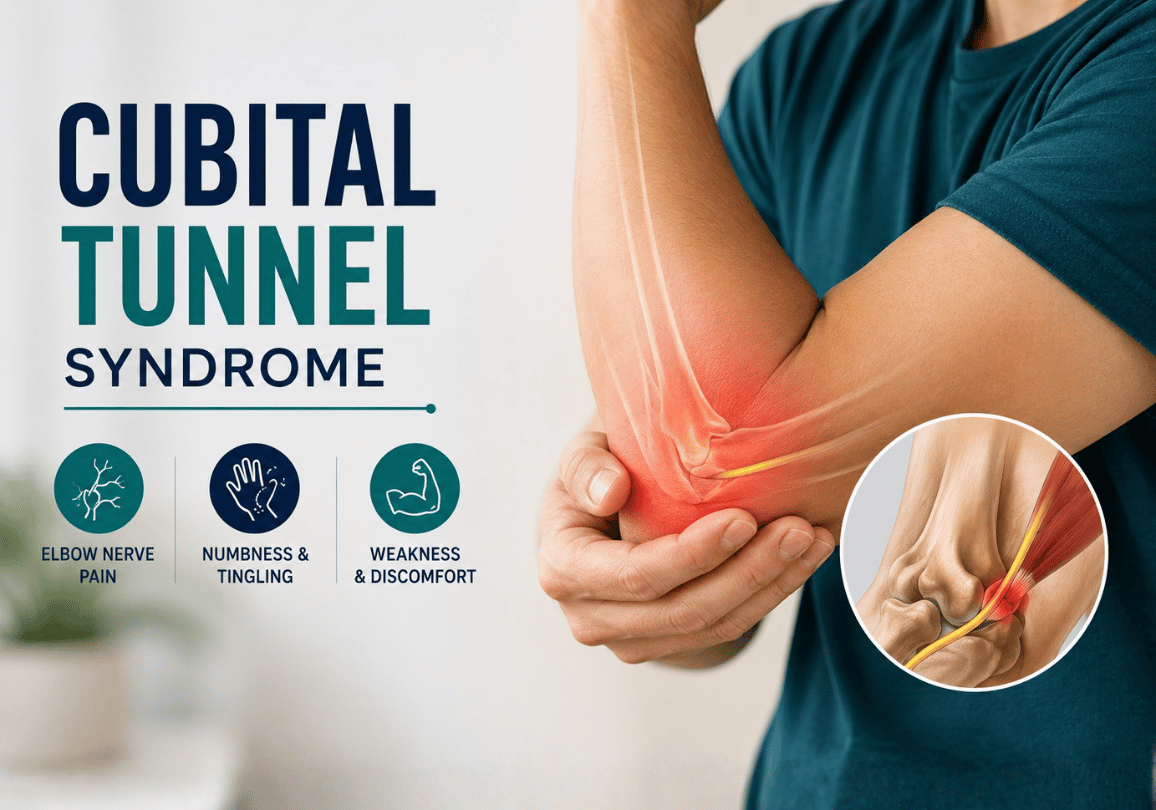
Cubital Tunnel Syndrome: Causes, Symptoms, and Elbow Nerve Pain Exercises
Cubital tunnel syndrome is elbow nerve pain, caused by compression or irritation of the ulnar nerve at the elbow, and it is more common than most people realise. It is the second most common nerve entrapment condition in the upper limb, behind only carpal tunnel syndrome.
Left unmanaged, what starts as intermittent tingling can progress to persistent numbness, grip weakness, and in advanced cases, visible wasting of the small muscles in the hand. Early recognition and the right rehabilitation approach make a significant difference to how far the condition is allowed to progress.
This article covers the causes of ulnar nerve entrapment at the elbow, how to recognise its symptoms, how severity is clinically graded, and what ulnar nerve physiotherapy involves at each stage. It also provides a practical guide to cubital tunnel exercises used in conservative rehabilitation.
What Is Cubital Tunnel Syndrome?
Cubital tunnel syndrome occurs when the ulnar nerve becomes compressed, stretched, or irritated as it passes through the cubital tunnel, a narrow passage on the inner side of the elbow formed by bone, ligament, and muscle.
The ulnar nerve is the nerve most people know informally as the funny bone nerve, because striking the inner elbow produces that characteristic shooting sensation into the ring and little fingers. That brief electric feeling is a normal nerve response to direct contact. In cubital tunnel syndrome, however, that same nerve is under chronic mechanical stress, and the resulting symptoms are far more persistent.
Cubital tunnel syndrome has a prevalence of 1.8-5.9% in the general population, with an annual incidence of approximately 25 cases per 100,000 person-years. It affects men roughly twice as often as women, according to PMC / Surgical Treatment of Cubital Tunnel Syndrome.
The ulnar nerve controls sensation in the little finger and the inner half of the ring finger, and provides the motor signals that power most of the small intrinsic muscles of the hand responsible for grip, pinch, and fine coordination. When compression disrupts these signals, both sensory and functional consequences follow.
Causes of Ulnar Nerve Entrapment at the Elbow
Elbow nerve compression develops through several mechanisms, most of which relate to posture, repetitive loading, or anatomical factors. Direct pressure on the nerve from sitting habits and occupational activities is a significant cause of ulnar nerve damage at the medial epicondyle.
Common causes and contributing factors include:
- Sustained elbow flexion: Bending the elbow past 90 degrees for extended periods stretches the ulnar nerve and increases pressure within the cubital tunnel.
- Habitual elbow leaning: Resting the elbow on a hard desk edge, armrest, or steering wheel places direct compressive force on the nerve at the point where it sits closest to the skin surface.
- Smartphone and device use: Sustained elbow flexion during smartphone use, rather than total screen time, is the primary postural risk factor linking device habits to cubital tunnel syndrome.
- Repetitive elbow flexion and extension: Occupational activities involving repeated bending and straightening, such as assembly work, carpentry, or certain throwing sports, can cause cumulative mechanical irritation along the nerve.
- Prior elbow injury: Fractures, dislocations, or direct blows to the elbow can cause swelling, scar tissue, or bone changes that narrow the cubital tunnel.
- Systemic health factors: Diabetes, obesity, smoking, and rheumatic conditions increase vulnerability to nerve compression by affecting peripheral nerve health and the mechanical properties of surrounding connective tissue.
- Anatomical predisposition: Some individuals have a naturally narrower cubital tunnel or a hypermobile ulnar nerve that snaps over the medial epicondyle during elbow flexion, both of which increase the risk of repeated nerve irritation.
Symptoms of Cubital Tunnel Syndrome
Symptoms follow the sensory and motor distribution of the ulnar nerve and typically develop gradually. Many patients have had intermittent tingling for months before seeking assessment.
- Tingling in ring finger and little finger: This is the most recognisable early symptom, and it is usually worse when the elbow is flexed.
- Funny bone nerve pain: A persistent aching, burning, or shooting sensation along the inner forearm and into the hand, distinct from the brief shock of hitting the elbow.
- Numbness along the inner hand: Reduced sensation along the ulnar border of the hand, extending to the little finger and half of the ring finger. As the condition progresses, numbness may become constant.
- Grip and pinch weakness: The ulnar nerve controls most of the intrinsic hand muscles. As nerve function deteriorates, patients notice difficulty opening jars, holding objects firmly, or performing tasks requiring precise finger coordination, such as typing or writing.
- Clumsiness with fine tasks: Buttoning a shirt, picking up small objects, and separating pieces of paper become noticeably difficult as intrinsic muscle function declines.
- Claw hand posture: In advanced, untreated cases, visible wasting of the hypothenar muscles and interosseous muscles causes a characteristic claw deformity of the ring and little fingers. This indicates significant nerve damage and requires specialist review.
Symptoms are typically aggravated by activities involving elbow flexion and relieved by keeping the elbow straight. If symptoms are present at rest and do not change with position, this usually indicates more advanced nerve involvement.
How Cubital Tunnel Syndrome Is Graded and Diagnosed
Diagnosis is primarily clinical: a physiotherapist or doctor identifies the symptom pattern, performs provocative tests including Tinel’s sign at the elbow and the elbow flexion compression test, and assesses grip strength and sensation in the ulnar nerve distribution.
Severity is graded using the McGowan classification, which guides treatment decisions and helps predict the urgency of surgical review.
| Grade | Symptoms | Clinical Findings | Recommended Approach |
| Grade I (Mild) | Intermittent tingling and numbness in ring and little fingers, especially with elbow bent | Positive Tinel sign at elbow. Normal or mild changes on nerve conduction. No muscle weakness. | Conservative first: activity modification, night splinting, nerve gliding exercises, physiotherapy |
| Grade II (Moderate) | Persistent tingling and numbness. Early hand weakness. Some difficulty with fine tasks. | Weakness of intrinsic hand muscles. No visible muscle wasting. EMG shows conduction slowing. | Conservative trial for 3 to 6 months. Surgery if no improvement or progressive weakness. |
| Grade III (Severe) | Constant numbness and weakness. Claw hand posture developing. Loss of grip and pinch strength. | Visible wasting of hand muscles. Claw hand deformity. Significant EMG abnormalities. | Surgical decompression or nerve transposition. Post-operative physiotherapy essential. |
Treatment: Ulnar Nerve Physiotherapy and Conservative Management
Treatment with ulnar nerve physiotherapy is the first-line approach for Grade I and most Grade II presentations. Early intervention consistently produces better outcomes than delayed treatment.
A physiotherapy programme for cubital tunnel syndrome typically involves:
- Activity modification and posture education: Patients learn to recognise and modify the specific positions and habits that provoke compression.
- Night splinting: A resting elbow splint worn at night keeps the elbow at approximately 45 degrees, preventing the prolonged bent position during sleep that is one of the most common aggravators.
- Nerve gliding and neurodynamic mobilisation: Guided movement sequences that encourage the ulnar nerve to move freely through its full path, reducing neural tension and preventing adhesion at the compression site.
- Soft tissue and manual therapy: Massage and mobilisation of the tissues around the cubital tunnel address myofascial tightness in the flexor muscles and the arcuate ligament that can contribute to nerve compression.
- Therapeutic modalities: Pulsed ultrasound and low-level laser therapy are used as adjuncts to reduce local inflammation and support nerve tissue recovery in the acute phase.
- Strengthening and functional rehabilitation: Once nerve symptoms are stabilising, progressive grip and forearm strengthening, combined with task-specific hand exercises, restores function and builds the muscular support.
Cubital Tunnel Exercises: A Practical Guide
Cubital tunnel exercises focus on two priorities: improving nerve mobility through the cubital tunnel and rebuilding the strength and coordination affected by nerve compression. During an acute flare with significant tingling or pain, gently perform nerve gliding exercises within a comfortable range.
Nerve Gliding Exercises
- Ulnar nerve slider: The slider moves the nerve through its path in opposite directions simultaneously, creating a gliding motion rather than sustained tension.
- Ulnar nerve tensioner: Used only when the slider is well-tolerated and symptoms are mild. This progressively loads the ulnar nerve from multiple points simultaneously. Stop immediately if pins and needles increase significantly.
- Cervical lateral flexion release: This reduces tension on the ulnar nerve proximally and is a useful offload technique during acute flares.
Elbow and Forearm Mobility
- Wrist flexor and forearm stretch: This reduces tightness in the flexor muscles that can compress the cubital tunnel during elbow flexion.
- Elbow range-of-motion circles: Maintain joint mobility and encourage fluid movement of the nerve within the tunnel.
Strengthening Exercises
Introduced once acute tingling is settling and nerve mobility is improving. All performed 10 to 15 repetitions, two to three times per week.
- Finger abduction and adduction: These target the interosseous muscles directly innervated by the ulnar nerve and are among the earliest functional indicators of nerve recovery.
- Thumb adduction strengthening: This directly tests and progressively loads the adductor pollicis, a key ulnar nerve-innervated muscle commonly weakened in cubital tunnel syndrome.
- Grip strengthening with putty or foam: Gentle, submaximal grip exercises using soft putty or a foam ball rebuild overall hand strength without loading the elbow in a provocative flexed position. Progress resistance gradually.
- Wrist ulnar deviation with resistance band: This reactivates the flexor carpi ulnaris, the forearm muscle with the most direct relationship to cubital tunnel anatomy.
Getting Expert Physiotherapy for Elbow Nerve Pain in Pune
Elbow nerve pain that is left unmanaged or managed incorrectly leads to a predictable deterioration that physiotherapy, started early, can prevent. At Healyos in Pune, our neurological physiotherapists provide individually assessed treatment for cubital tunnel syndrome through physiotherapy at home, in-clinic sessions, and online consultations across Pune and Navi Mumbai. Every programme begins with a clinical assessment of nerve involvement, symptom grading, and provocative test findings before any exercise prescription begins.
Key Takeaways
- Cubital tunnel syndrome is the second most common nerve entrapment condition in the upper limb, caused by compression of the ulnar nerve at the inner elbow.
- Sustained elbow flexion, habitual elbow leaning, repetitive bending, and device use in bent-elbow positions are the primary modifiable causes.
- Symptoms follow the distribution of the ulnar nerve: tingling in the ring finger and little finger, elbow nerve pain, inner forearm aching, and progressive grip and pinch weakness if compression persists.
- Severity is graded by the McGowan classification. Grade I and most Grade II cases are managed conservatively. Grade III with muscle wasting requires urgent surgical review.
- Conservative management with 73% to 100% improvement rates across studies includes activity modification, night splinting, nerve gliding exercises, and progressive strengthening.
- Cubital tunnel exercises focus first on ulnar nerve mobility through gliding techniques, then on restoring the finger intrinsic and grip strength that nerve compression progressively depletes.
- Physiotherapy cannot reverse advanced axonal damage. Grade III cases with constant numbness and visible muscle wasting need surgical decompression followed by post-operative physiotherapy.
Frequently Asked Questions
Q1. Can cubital tunnel syndrome resolve on its own?
Yes, in mild cases where the cause is a temporary or correctable postural habit. Grade I cubital tunnel syndrome with only intermittent tingling often improves significantly once provocative postures are identified and corrected, with or without formal physiotherapy. More persistent Grade I and Grade II cases do not reliably resolve without structured conservative management. Waiting without intervention allows nerve compression to progress from reversible to irreversible stages.
Q2. What is the difference between cubital tunnel syndrome and carpal tunnel syndrome?
Cubital tunnel syndrome involves compression of the ulnar nerve at the elbow, producing tingling in the ring and little fingers and weakness in the inner hand. Carpal tunnel syndrome involves compression of the median nerve at the wrist, producing tingling in the thumb, index, middle, and outer ring fingers. Both are nerve entrapment conditions, but they affect different nerves at different locations and require different treatment approaches.
Q3. How long does treatment of the ulnar nerve with physiotherapy take?
Most patients with Grade I or mild Grade II cubital tunnel syndrome see meaningful improvement within 4 to 8 weeks of consistent conservative management, including activity modification, night splinting, and nerve gliding exercises. Full resolution of tingling and restoration of grip strength may take 3 to 6 months, depending on how long the nerve has been under compression. Longer symptom duration before treatment begins is directly associated with slower and less complete recovery.
Q4. Are cubital tunnel exercises safe to do at home?
Yes, gentle nerve gliding exercises are generally safe to perform at home once a physiotherapist has assessed the severity of nerve involvement and demonstrated correct technique. The key rule is that exercises must stay within a range that does not significantly increase tingling or pain. If any exercise produces a marked increase in symptoms, stop and contact your physiotherapist before continuing. Strengthening exercises should not be attempted without physiotherapy guidance during the acute phase.
Q5. Is surgery always needed for cubital tunnel syndrome?
No, surgery is reserved for Grade III cases with significant muscle wasting and irreversible nerve damage, and for Grade I and II cases that fail to improve after a serious trial of conservative physiotherapy over 3 to 6 months.The majority of mild-to-moderate presentations respond well to activity modification, night splinting, and targeted physiotherapy, without requiring surgical decompression or nerve transposition.
Q6. Can sleeping position cause or worsen cubital tunnel syndrome?
Yes, sleeping with the elbow bent, whether tucked under the pillow, bent tightly against the chest, or curled beneath the head, sustains ulnar nerve stretch for hours at a time and is one of the most commonly reported causes of nighttime tingling in ring and little fingers. Sleeping with the elbow supported in a near-straight position, using a pillow alongside the arm or wearing a night splint, is one of the simplest and most effective early interventions.
Q7. Does Healyos provide physiotherapy for cubital tunnel syndrome and elbow nerve pain at home in Pune?
Yes, Healyos provides neurological and orthopaedic physiotherapy for cubital tunnel syndrome and elbow nerve pain through home visits, in-clinic sessions, and online consultations across both cities. Our physiotherapists conduct a clinical assessment, review nerve conduction studies, review provocative test findings, and assess functional deficits before prescribing treatment. You can book a consultation online to arrange your initial assessment.

Leave a Reply