 +919325609388

 +919325609388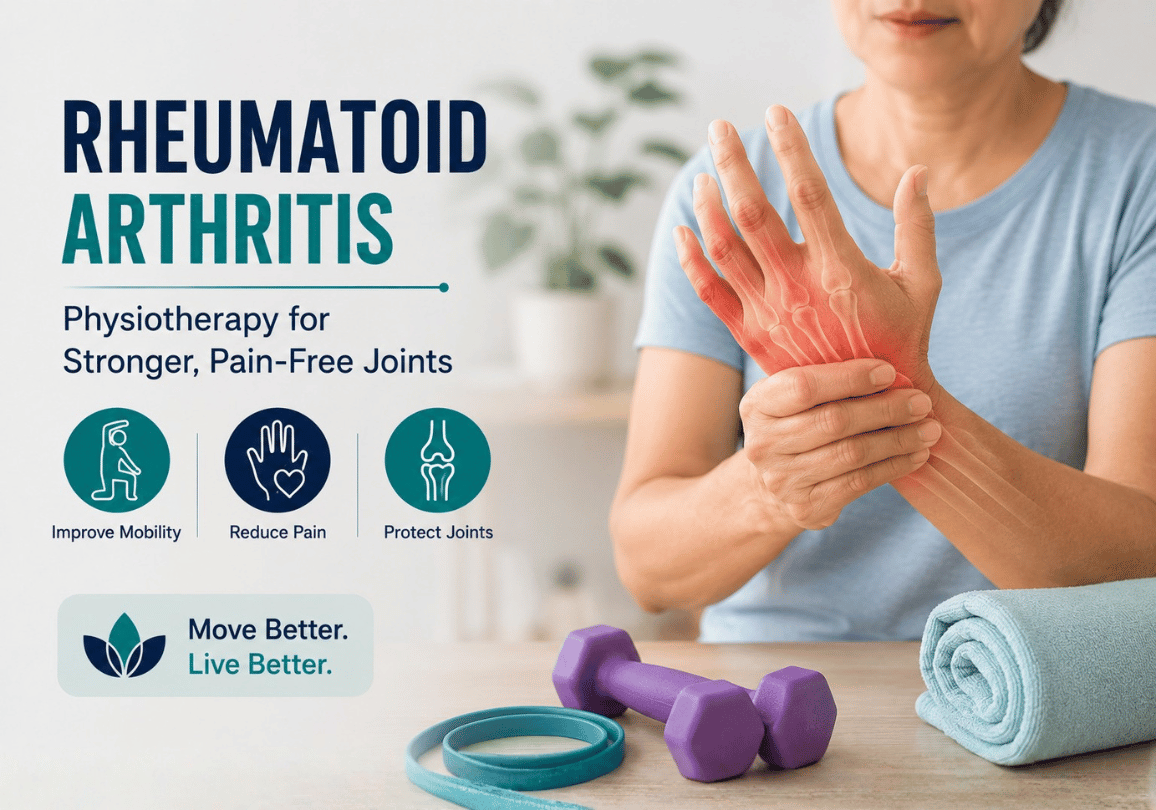
Rheumatoid Arthritis and Physiotherapy: Managing Joint Pain Without Medication
Rheumatoid Arthritis and Physiotherapy: Managing Joint Pain Without Medication
Rheumatoid arthritis (RA) is a chronic autoimmune disease in which the immune system mistakenly attacks the lining of the joints, causing inflammation, pain, swelling, and stiffness. Unlike osteoarthritis, which develops from wear and tear over time, RA can affect people at any age and may progressively damage joints if not properly managed.
Living with RA can make everyday activities such as walking, writing, cooking, or getting dressed increasingly difficult. While medication helps control inflammation and slow disease progression, many people continue to struggle with pain, reduced mobility, muscle weakness, and limitations in daily function.
This is where rheumatoid arthritis physiotherapy plays an important role. Alongside medical treatment, physiotherapy helps improve movement, maintain strength, protect vulnerable joints, and support greater independence in daily life. This blog explores how physiotherapy fits into RA management, including exercise therapy, joint protection techniques, and other non-drug strategies that can help reduce pain and improve quality of life.
What is Rheumatoid Arthritis?
Rheumatoid arthritis is a systemic autoimmune condition that primarily affects the synovial joints, causing persistent inflammation within the joint lining. Over time, this inflammation can damage cartilage, erode bone, and lead to reduced mobility and disability if left inadequately managed.
The condition most commonly affects the hands, wrists, feet, and knees, often involving the same joints on both sides of the body. Because RA affects more than just the joints, it is also associated with an increased risk of complications such as cardiovascular disease, osteoporosis, and depression.
A study published in PMC (2025), Burden of RA in India from 1990 to 2021 using the Global Burden of Disease database, found that the incidence, prevalence, and disability burden of RA in India have increased steadily over the past three decades and are projected to continue rising through 2036. These findings highlight the growing need for comprehensive treatment approaches that address both disease control and long-term function.
Managing RA Without Medication: Where Physiotherapy Fits In
Managing RA without medication completely is not a goal that physiotherapy supports or advocates. Disease-modifying antirheumatic drugs (DMARDs) and biologics remain the foundation of RA treatment because they target the underlying inflammatory process that drives joint destruction. Physiotherapy cannot replicate this.
What physiotherapy achieves through exercises for RA joint protection using techniques, which medication alone cannot, is:
- Restoring and maintaining joint range of motion: Chronic inflammation can cause progressive joint stiffening. Physiotherapy-guided movement prevents and reverses this loss.
- Rebuilding muscle strength: RA causes significant muscle wasting around affected joints. Weakness then accelerates joint damage by removing the muscular protection that joints depend on. Exercise rebuilds this protection.
- Reducing pain through physical means: Manual therapy, therapeutic exercise, heat and cold application, and TENS reduce pain through neurological and biomechanical mechanisms that medication does not address.
- Teaching joint protection techniques: Physiotherapists train patients in movement strategies that reduce mechanical stress on vulnerable joints during daily activities.
- Improving fatigue and quality of life: A systematic review published in PMC (2025) found that rehabilitation interventions added to DMARD therapy produced meaningful improvements in physical function.
The most effective RA management combines medication with structured rehabilitation. The evidence is consistent: patients who receive both achieve better functional outcomes than those receiving medication alone.
Exercise and Rheumatoid Arthritis: What Research Confirms
A persistent and damaging misconception about RA is that exercise worsens joint inflammation and should be avoided during active disease. This is incorrect. A systematic review and meta-analysis published in Frontiers in Physiology (2025) found that exercise therapy produced meaningful improvements in pain, fatigue, bone function, and quality of life.
A further systematic review published in PMC (2025), Efficacy of Therapeutic Exercises for Rheumatoid Arthritis, found that different exercise programmes consistently improved functionality, reduced pain, and improved quality of life. Exercises are therefore not a risk for RA patients. Inactivity is.
The two most evidence-supported exercise types for RA are:
- Aerobic exercise: Moderate-intensity activity such as walking, swimming, and cycling for 30 minutes on most days of the week. Aerobic exercise reduces cardiovascular risk, improves fatigue, and produces systemic anti-inflammatory effects.
- Progressive resistance training: Strengthening exercises using resistance bands, weights, or body weight 2 to 3 times weekly. Resistance training rebuilds the peri-articular muscle mass that RA progressively depletes.
Exercise should be adapted during disease flares. During an acute flare affecting a specific joint, that joint is rested while the rest of the body continues to move. Your physiotherapist adjusts the programme based on current disease activity, not a fixed protocol.
Staying Active with RA While Protecting Your Joints
Joint protection is a set of behavioural and movement strategies taught by physiotherapists to reduce mechanical stress on inflamed joints during daily activities.
Core joint protection principles include:
- Distribute load across large joints: Instead of lifting a bag with finger joints, carry it over the forearm or shoulder. Instead of gripping the mug handle, use both hands to hold it from the sides. Large joints tolerate load significantly better than small joints.
- Avoid sustained grip and pinch: Prolonged gripping activities, such as writing, peeling vegetables, or squeezing objects, load the small joints of the hand directly. Break tasks into short intervals with rest between, or use ergonomic tools.
- Respect pain signals: Pain persisting for more than 1 hour after an activity indicates the activity was too stressful for the joint’s current state. Adjust the task duration, method, or tools before repeating it.
- Use assistive devices: Key turners, jar openers, button hooks, tap turners, and trolleys are practical tools that maintain independence while reducing joint loading.
- Maintain joint alignment during tasks: Avoid deviating the wrist toward the little finger (ulnar deviation) during gripping or carrying. This position is mechanically stressful for RA-affected wrist and hand joints and can worsen ulnar drift over time.
- Balance rest and activity: Energy conservation through planned rest periods between demanding activities reduces overall fatigue and prevents overexertion.
Rheumatoid Arthritis Hand Exercises: Evidence and Technique
Rheumatoid arthritis hand exercises are among the most frequently prescribed and evidence-supported components of RA rehabilitation. A systematic review published in Clinical Rheumatology (2014) found that grip strength across all grip types (power grip, key pinch, precision pinch, and tripod pinch) improved with hand exercise therapy without adverse effects on pain or disease activity.
The following exercises are used in structured rheumatoid arthritis hand exercise programmes. All must be performed within a pain-free or minimally uncomfortable range. Do not force any movement, and avoid these exercises during an acute joint flare unless your physiotherapist has specifically advised otherwise.
- Finger extension and flexion: Slowly open the hand as wide as possible, spreading the fingers, then close into a loose fist. Perform 10 repetitions. This maintains the range of motion of the metacarpophalangeal joints and counteracts flexion contractures.
- Tendon gliding sequence: From a straight hand, move progressively through four positions: straight fingers, hook fist (fingertips bent with proximal joints straight), full fist, and tabletop position (fingers straight and bent at the knuckles). Hold each position 3 seconds and perform 5 to 8 repetitions. This prevents adhesion within the tendon sheaths.
- Thumb opposition: Touch the tip of the thumb to each fingertip in sequence, forming a circle. Perform 10 repetitions on each hand. This maintains thumb mobility and the functional pinch patterns needed for daily tasks.
- Wrist flexion and extension: With the forearm supported on a flat surface and the hand hanging free, gently bend the wrist upward (extension) and downward (flexion) through a comfortable range of motion. Perform 10 repetitions. Wrist mobility is essential for almost all hand function tasks.
- Radial and ulnar deviation: With the forearm resting, gently move the hand toward the thumb side (radial deviation) and toward the little finger side (ulnar deviation) alternately. Perform 8 to 10 repetitions. Maintaining radial deviation range counteracts the ulnar drift that develops in longstanding RA.
- Gentle grip strengthening: Squeeze a soft foam ball, putty, or rolled towel with a comfortable, submaximal grip. Hold for 3 to 5 seconds, then release fully. Perform 10 repetitions. Progress to firmer resistance only when pain allows.
How to Reduce RA Inflammation Naturally: Lifestyle Evidence
Non-drug RA management encompasses a range of evidence-based lifestyle strategies that complement physiotherapy and medication. These are not alternative treatments. They are adjunctive strategies that work through distinct biological mechanisms to reduce systemic inflammation, lower disease activity, and improve quality of life.
Anti-Inflammatory Diet
Mediterranean, anti-inflammatory, and vegetarian diets all improve disease activity, physical function, and overall health in RA patients. The dietary pattern most consistently supported is: increased oily fish (2 to 3 servings weekly), fruits and vegetables with high antioxidant content, whole grains, and olive oil, combined with reduced processed foods, refined sugar, and red meat.
Sleep Quality
Poor sleep is an independent driver of RA pain amplification and disease activity. The immune dysregulation that occurs with insufficient sleep elevates pro-inflammatory cytokines, worsening RA. Patients should prioritise 7 to 9 hours of sleep and discuss sleep disturbances caused by pain or medication with their physician. A physiotherapist can advise on pain-reducing sleeping positions and pillow support strategies.
Stress Reduction
Psychological stress elevates systemic inflammation. For RA patients, sustained stress directly amplifies disease activity. Structured stress-reduction approaches, including mindfulness-based stress reduction (MBSR), diaphragmatic breathing, and paced activity, have measurable anti-inflammatory effects and improve RA-related fatigue.
Weight Management
Maintaining a healthy body weight reduces the systemic burden of pro-inflammatory adipokines. Combined aerobic and resistance exercise is the most effective physiotherapy-supported intervention for weight management in RA patients because it improves body composition without loading vulnerable joints as high-impact activity would.
Getting Expert Physiotherapy for Rheumatoid Arthritis in Pune
Rheumatoid arthritis physiotherapy requires a practitioner who understands the specific demands of autoimmune joint disease, the impact of disease activity on exercise tolerance, and how to sequence rehabilitation safely across flares and remission phases. At Healyos in Pune, our physiotherapists provide individually assessed rehabilitation for RA through physiotherapy at home, in-clinic sessions, and online consultations. Every programme begins with a joint-by-joint functional assessment and is designed to work alongside your rheumatologist’s medical treatment plan.
Key Takeaways
- Rheumatoid arthritis (RA) is an autoimmune disease that causes chronic joint inflammation, pain, stiffness, and progressive joint damage if not properly managed.
- Physiotherapy does not replace medications such as DMARDs or biologics, but it plays a vital role in improving mobility, strength, pain management, and daily function.
- Research consistently shows that combining physiotherapy with medical treatment leads to better functional outcomes than medication alone.
- Regular exercise is safe for most people with RA and can reduce pain, fatigue, and disability while improving overall quality of life.
- Aerobic exercise and progressive resistance training are among the most effective exercise approaches for maintaining joint health and physical function in RA.
- Joint protection techniques, including load distribution, ergonomic modifications, and activity pacing, help reduce stress on inflamed joints during everyday tasks.
- Hand exercises can improve grip strength, maintain mobility, and support independence in daily activities when performed correctly, without worsening disease activity.
- Lifestyle factors such as an anti-inflammatory diet, quality sleep, stress management, and healthy weight maintenance can complement physiotherapy and medical treatment to support long-term RA management.
Frequently Asked Questions
Q1. Can physiotherapy reduce joint pain from rheumatoid arthritis without increasing medication?
Yes, Physiotherapy reduces joint pain that rheumatoid arthritis patients experience through exercise, manual therapy, and joint protection education, all of which work through mechanisms independent of medication. Physiotherapy is not a replacement for DMARDs but consistently improves pain and function outcomes when added to medical treatment.
Q2. Is it safe to exercise during an RA flare?
During an acute flare affecting specific joints, those joints are rested while the rest of the body continues with gentle movement. Aerobic activity, such as walking or swimming, is generally maintained unless the flare involves lower limb weight-bearing joints. Your physiotherapist will adapt the programme to your current disease activity level. The key principle is that complete rest during a flare leads to faster deconditioning and worsens recovery, so guided gentle movement is preferable to inactivity.
Q3. What makes physiotherapy for autoimmune arthritis different from general physiotherapy?
Physiotherapy for autoimmune arthritis must account for the fluctuating nature of disease activity, the risk that exercise can worsen an active flare in the affected joint, the systemic nature of RA beyond the joints, and the specific joint protection principles that differ from those of mechanical injury rehabilitation. A physiotherapist experienced in RA will also understand how biologics and DMARDs affect fatigue and immune function, and will adjust treatment accordingly. General orthopaedic physiotherapy protocols are not appropriate for active RA without modification.
Q4. How often should rheumatoid arthritis hand exercises be done?
Rheumatoid arthritis hand exercises are most beneficial when performed daily. A 10 to 15 minute session in the morning, after morning stiffness has reduced, and another short session in the evening, works well for most patients. During a flare of the finger or wrist joints, the exercise set is modified to only very gentle active range-of-motion movements within a pain-free range, with resistive exercises paused until the flare subsides.
Q5. Does managing RA without medication mean stopping DMARDs?
No, Managing RA without medication in the context of physiotherapy refers specifically to addressing the components of RA that medication does not target: physical function, strength, movement, joint protection, and daily activity capacity. It does not mean stopping or reducing DMARDs or biologics. Disease-modifying therapy remains the cornerstone of RA management because it targets the immune-mediated process driving joint destruction. Physiotherapy and non-drug RA management approaches work alongside medication, not instead of it.
Q6. Which dietary changes most effectively reduce RA inflammation naturally?
To reduce RA inflammation naturally through diet, the most evidence-supported changes are increasing omega-3-rich foods such as oily fish (salmon, mackerel, sardines) and, if needed, supplementing with 2 to 3 grams of combined EPA and DHA daily. Adopting a Mediterranean dietary pattern, rich in vegetables, whole grains, legumes, and olive oil, while reducing red meat and processed food, also improved disease activity and physical function across multiple studies. These changes complement medication and physiotherapy but do not replace them.
Q7. Does Healyos provide rheumatoid arthritis physiotherapy at home in Pune?
Yes, Healyos provides rheumatoid arthritis physiotherapy through home visits, in-clinic sessions in Pune, and online consultations. Our physiotherapists are trained in RA-specific exercise prescription, joint protection education, hand rehabilitation, and disease activity-adapted programming. Home visits are particularly suited to patients whose mobility or fatigue during a flare makes travel to a clinic difficult. You can book a consultation online to arrange an assessment.

Leave a Reply