 +919325609388

 +919325609388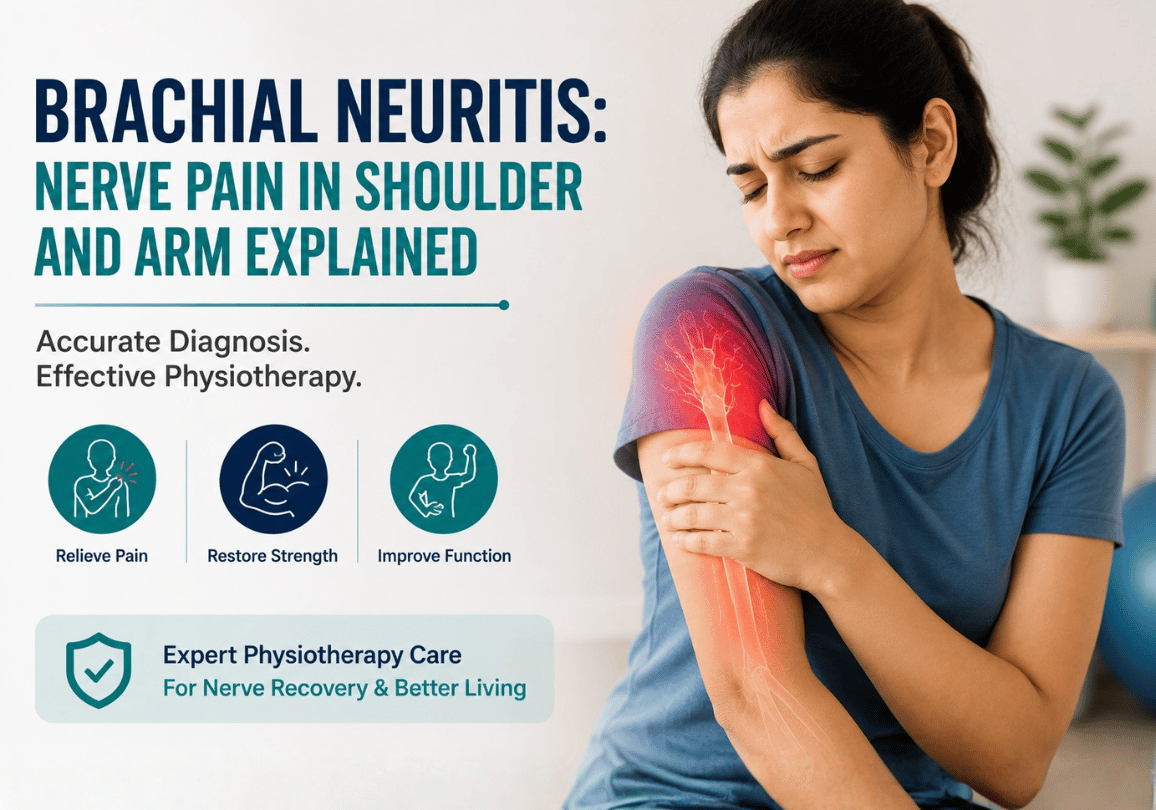
Brachial Neuritis: Shoulder and Arm Nerve Pain Diagnosis and Physiotherapy
Brachial neuritis is a condition characterised by sudden, severe, burning pain in the shoulder and upper arm that can feel unlike anything the patient has experienced before. Within days or weeks, that intense pain gives way to a different problem, weakness and wasting in the muscles of the shoulder and arm, as the inflamed nerves stop sending signals properly.
The two phases of brachial neuritis are so distinct, and the condition is so relatively rare that it is frequently misdiagnosed as a rotator cuff injury, frozen shoulder, or cervical disc problem, delaying the treatment that patients urgently need.
What Is Brachial Neuritis?
Brachial neuritis, also called Parsonage-Turner syndrome or neuralgic amyotrophy, is an inflammatory condition of the brachial plexus, the network of nerves that runs from the spinal cord through the neck and into the shoulder, arm, and hand. Sudden shoulder pain and weakness occurring days apart is one of the hallmark signs of brachial neuritis. According to StatPearls/NCBI, the primary characteristic symptoms are sharp, unilateral shoulder and arm pain followed by the onset of muscle weakness, with symptoms typically radiating to the neck, arms, and forearms.
Two forms exist. Idiopathic brachial neuritis occurs without a clear identifiable cause, though immune-mediated triggers are strongly suspected. Hereditary brachial plexus neuropathy is a rarer genetic variant linked to mutations in the SEPT9 gene, characterised by recurrent attacks and a family history of the condition.
Symptoms of Brachial Neuritis: What to Watch For
Brachial neuritis presents in two distinct phases. Understanding this biphasic pattern is critical because the two phases can appear to be entirely different conditions, leading to diagnostic confusion.
Phase 1: Acute Pain Phase
The acute phase begins suddenly and is the defining feature of brachial neuritis. Symptoms include:
- Sudden, severe shoulder and arm pain: Onset is abrupt, often starting at night or at rest. The pain is typically described as sharp, burning, or stabbing and is felt most intensely around the shoulder girdle, upper arm, and sometimes the neck.
- Pain that worsens at night: Nocturnal worsening is a hallmark of brachial neuritis and helps distinguish it from mechanical shoulder problems.
- Radiation into the arm and hand: Pain frequently radiates down the upper arm, forearm, and occasionally into the hand and fingers, following the distribution of the affected nerve branches.
- Hypersensitivity of the skin: Some patients experience allodynia, where even light touch on the affected arm causes pain. This reflects the inflammatory nerve involvement.
- Restricted shoulder movement due to pain: Movement limitation is primarily pain-driven rather than structural.
Phase 2: Weakness Phase
Within days to a few weeks, the acute pain typically begins to subside. This is when the second, more functionally disabling phase becomes apparent:
- Muscle weakness in the shoulder and arm: Weakness can range from mild to near-complete paralysis of specific muscle groups.
- Muscle wasting (atrophy): As the nerve supply to affected muscles is disrupted, visible thinning of the shoulder and upper arm musculature can develop over weeks.
- Scapular winging: When the serratus anterior or trapezius muscles are affected, the shoulder blade protrudes abnormally from the back, a visible sign that is pathognomonic of nerve involvement.
- Sensory changes: Numbness, tingling, or reduced sensation in patches of the arm, shoulder, or hand may occur, though sensory involvement varies among patients.
- Residual, lower-intensity pain: Even after the acute phase, a dull aching or burning discomfort in the shoulder and arm often persists for months during the recovery period.
Causes of Brachial Neuritis: Why It Happens
The precise cause of brachial neuritis remains incompletely understood. The leading hypothesis is that it involves an abnormal immune-mediated inflammatory response, in which the immune system attacks the nerves of the brachial plexus, typically triggered by an identifiable or unidentifiable preceding event.
Known triggers and associated factors include:
- Viral infections: Upper respiratory tract infections are the most commonly documented infectious trigger. Other viruses, including hepatitis E, HIV, and Epstein-Barr virus, have also been associated with brachial neuritis.
- Bacterial infections: Pneumonia, typhoid, diphtheria, and other systemic bacterial illnesses have been linked to the onset of brachial neuritis.
- Vaccinations: Immunisations are estimated to account for 15% of brachial neuritis cases, according to a review published in Cureus (2023). Influenza, tetanus, and, more recently, COVID-19 vaccines have all been associated with post-vaccination onset.
- Surgery: Among non-idiopathic episodes of brachial neuritis, the majority are associated with surgery, including orthopaedic, cardiac, and oral surgical procedures, not necessarily near the shoulder.
- Physical stress and trauma: Strenuous physical exertion, direct trauma to the shoulder or neck, or forceful arm stretching can trigger the condition in susceptible individuals.
- Systemic autoimmune conditions: Conditions such as systemic lupus erythematosus, polyarteritis nodosa, and Ehlers-Danlos syndrome are associated with a higher risk of brachial neuritis.
- Hereditary predisposition: Mutations in the SEPT9 gene, identified in 2005, produce a hereditary variant characterised by recurrent attacks of brachial plexus pain, often with less severe weakness than the idiopathic form.
In a significant proportion of cases, no trigger is ever identified. Brachial neuritis occurs in otherwise healthy individuals with no prior illness, injury, or family history. It is slightly more common in males and most often presents between the ages of 20 and 50.
Diagnosing Brachial Neuritis
Brachial neuritis is primarily a clinical diagnosis, meaning it is diagnosed based on a thorough patient history and physical examination. According to NCBI StatPearls (2024), clinicians frequently misdiagnose brachial neuritis due to its multifocal symptoms, variable presentations, and delayed pathophysiological changes on diagnostic testing.
The key clinical clue is the temporal pattern: severe pain appears first,followed by weakness develops days to weeks later. In cervical radiculopathy and rotator cuff injuries (the two most common misdiagnoses), pain and weakness typically occur simultaneously. This time-separated sequence is the most diagnostically important feature of brachial neuritis.
An accurate diagnosis is critical because misdiagnosis can lead to unnecessary surgery and prolonged suffering.
Physiotherapy for Brachial Neuritis: Treatment by Phase
Physiotherapy is the cornerstone of recovery from brachial neuritis. According to Medscape (2024), physical therapy for brachial neuritis should focus on maintaining a full range of motion in the shoulder and affected joints, with passive and active range-of-motion exercises beginning as soon as pain is adequately controlled. Nerve pain shoulder physiotherapy focuses on restoring movement while protecting recovering nerves from overload. A comprehensive, structured rehabilitation programme focusing on range of motion, neuromuscular re-education, and progressive strengthening is essential for regaining function and reducing long-term disability.
It is important to understand one critical limitation: strengthening exercises are not recommended for muscles in a state of complete denervation (full loss of nerve supply). Attempting to strengthen a muscle that the nerve cannot yet activate will not produce results and may cause joint harm. This is why an accurate diagnosis and ongoing EMG monitoring are essential before the strengthening phase begins. A neurological physiotherapist will assess the level of reinnervation before progressing the programme.
| Phase | Timing | Primary Goal | Physiotherapy Focus |
| Acute Pain Phase | Days 1-14 (may extend to 4 weeks) | Pain control; rest; prevent joint stiffness | Gentle pendulum movements, passive ROM, sling support, ice/heat, positioning advice |
| Sub-Acute Phase | Weeks 4-12 | Restore range of motion; address spasticity | Active-assisted ROM, TENS for pain, gentle scapular mobilisation, postural correction |
| Strengthening Phase | Months 3-6 | Rebuild rotator cuff and scapular stability | Rotator cuff exercises (isometric progressing to isotonic), scapular stabiliser training, proprioception drills |
| Functional Phase | 6 months – 2+ years | Restore full function; prevent recurrence | Task-specific upper limb training, nerve gliding exercises, return to work/sport conditioning |
Recommended Brachial Neuritis Exercises
The following exercises represent the types of movements used for brachial neuritis rehabilitation. All must be guided and supervised by a qualified physiotherapist who assesses the patient’s nerve recovery, pain levels, and muscle response before progressing between phases. Do not attempt strengthening exercises if severe pain persists or if the muscles remain completely denervated.
- Pendulum exercises (acute phase): Standing and leaning forward, allow the affected arm to hang freely and swing in small clockwise and anticlockwise circles using gentle gravity-assisted movement.
- Passive shoulder range-of-motion (acute to sub-acute): With the assistance of a therapist or the unaffected arm, the shoulder is gently moved through flexion, abduction, internal and external rotation, and horizontal adduction to maintain joint flexibility and prevent the capsular tightening.
- Cervical and thoracic postural correction (sub-acute phase): Targeted postural correction exercises prevent the development of secondary myofascial pain and biomechanical dysfunction in the neck and upper back.
- Scapular stabilisation exercises (strengthening phase): Once reinnervation begins, exercises targeting the serratus anterior, lower and middle trapezius, and rhomboids are introduced to address scapular winging and restore the stable platform needed for shoulder and arm function.
- Rotator cuff strengthening (strengthening phase): Isometric exercises begin the strengthening phase when pain allows. They progress to isotonic exercises using resistance bands and light weights as motor function returns.
- Nerve gliding exercises (throughout recovery): These gentle exercises move the nerve through its full excursion path, reducing neural tension and improving nerve mobility within its surrounding tissues.
- Proprioception and neuromuscular re-education (functional phase): As motor function returns, the nervous system must relearn precise movement control. Techniques including balance board work for the upper limb, closed-chain exercises, and task-specific training help restore the neuromuscular coordination needed for daily activities and return to work or sport.
Recovery Timeline and Prognosis: What to Expect
Recovery from brachial neuritis is generally favourable but slow. According to Medscape (2024), 80% of patients recover functionally within 2 years and 90% within 3 years. A widely used clinical rule of thumb describes that approximately one-third of patients recover within one year, two-thirds within two years, and most of the remainder within four years.
Pain typically resolves first, often within 4-8 weeks, though it can persist for several months in more severe cases. Muscle strength returns more slowly, as it depends on the rate of nerve regeneration. Since nerves regenerate at approximately 1 millimetre per day, recovery timelines are proportional to the distance between the injury site and the affected muscles. Muscles closer to the spine recover faster than those in the forearm or hand.
Factors associated with a poorer prognosis include bilateral involvement, lower trunk brachial plexus lesions, severe muscle atrophy on initial presentation, and EMG findings showing greater than 70% reduction in motor action potential amplitude. In a small proportion of patients, complete strength recovery is not achieved, and long-term management focuses on functional adaptation and pain management.
Getting Right Care for Brachial Neuritis
Brachial neuritis requires a physiotherapist with specific neurological training, not a general shoulder rehabilitation programme. The assessment must account for nerve recovery status, current denervation levels, spasticity patterns, and the gradual reintroduction of strengthening at the correct phase. Applying standard rotator cuff protocols to a patient with active denervation is ineffective and can cause harm.
At Healyos, our neurological physiotherapy team is specifically trained to manage conditions of the brachial plexus and peripheral nervous system. Each programme begins with a thorough neurological and functional assessment, with exercises progressed strictly according to confirmed nerve recovery status, not estimated timelines.
Key Takeaways
- Brachial neuritis is a rare inflammatory condition of the brachial plexus, with an estimated incidence of 1.64-3 per 100,000 per year.
- The condition presents in two phases: sudden, severe shoulder and arm pain lasting 1-4 weeks, followed by muscle weakness, wasting, and sometimes scapular winging as the nerve supply is disrupted.
- Known triggers include viral and bacterial infections, vaccinations, surgery, physical trauma, and autoimmune conditions. In many cases, no trigger is identified.
- Misdiagnosis is common. Brachial neuritis is most frequently confused with rotator cuff pathology, frozen shoulder, and cervical radiculopathy.
- Physiotherapy is the cornerstone of recovery, but must be phase-specific. Strengthening exercises are contraindicated in fully denervated muscles. A neurological physiotherapist must assess reinnervation status before progressing rehabilitation.
- Prognosis is generally good: Pain resolves earlier than strength, and recovery timelines depend on the severity of nerve damage and the distance nerves must regenerate.
- Any sudden, severe, unexplained shoulder or arm pain, especially with subsequent weakness or sensory changes, should be evaluated by a doctor promptly. Early diagnosis prevents mismanagement and improves long-term outcomes.
Frequently Asked Questions
Q1. How is brachial neuritis different from a rotator cuff tear or frozen shoulder?
The key difference is the pattern of onset. Brachial neuritis begins with sudden, severe, burning nerve pain, followed days to weeks later by muscle weakness and wasting. Rotator cuff tears and frozen shoulder both cause pain and movement restriction, but they do not produce the same acute nerve pain or the subsequent visible muscle wasting. EMG, nerve conduction studies, and MRI of the brachial plexus and cervical spine are used to confirm the diagnosis and exclude these other conditions.
Q2. Can brachial neuritis resolve on its own without physiotherapy?
Brachial neuritis typically improves over time in most patients, with 80% achieving functional recovery within 2 years. However, without physiotherapy, secondary complications, including joint stiffness, contracture, muscle imbalance, and chronic pain, can develop during the recovery period and significantly delay or limit final outcomes. Physiotherapy does not accelerate nerve regeneration itself, but it maintains joint mobility, prevents secondary damage, and rebuilds strength appropriately as nerve supply returns.
Q3. How long does brachial neuritis last?
The acute pain phase typically lasts 1-4 weeks, though in some patients it can persist for several months. The weakness and recovery phase, which depends on nerve regeneration, typically takes 1-3 years. Approximately one-third of patients achieve full functional recovery within 1 year, two-thirds within 2 years, and 90% within 3 years. A small proportion of patients experience persistent weakness beyond 3 years, particularly when initial nerve damage is severe.
Q4. When can I start exercises for brachial neuritis?
Gentle pendulum and passive range-of-motion exercises can begin as soon as pain is sufficiently controlled, even in the acute phase, to maintain joint mobility. Active exercises and strengthening should not begin until pain has significantly reduced and a physiotherapist has confirmed some degree of muscle reinnervation through assessment. Strengthening a fully denervated muscle is not effective and risks secondary joint injury. The timing and type of exercise must be individually guided by your physiotherapist.
Q5. Can brachial neuritis recur?
Yes. In the hereditary form (hereditary neuralgic amyotrophy), the recurrence rate is approximately 75%, often triggered by events similar to those that caused the first attack. In the idiopathic form, recurrence rates are estimated at 5-26%. Anyone with a known or suspected hereditary variant should discuss preventive strategies and genetic testing with their neurologist.
Q6. Is brachial neuritis related to COVID-19 or COVID-19 vaccination?
A systematic review published in MDPI Biomedicines (2023) confirmed that Parsonage-Turner syndrome has been reported following both SARS-CoV-2 infection and COVID-19 vaccination. A review of published cases in Cureus (2023) identified 59 post-vaccination cases, most of which presented within 2 weeks of vaccination. The proposed mechanism is immune-mediated, involving molecular mimicry or bystander immune activation. Anyone who develops sudden, severe shoulder and arm pain within 4 weeks of a vaccination should seek medical evaluation.
Q7. Does Healyos treat brachial neuritis and brachial plexus conditions?
Yes, Healyos provides dedicated neurological physiotherapy for brachial neuritis, brachial plexus neuropathy, and related nerve pain conditions. Our physiotherapists are trained specifically in neurological assessment and rehabilitation, and all programmes are based on individual clinical assessment, including nerve recovery status. Home visits, and online consultations are available. Book an online consultation to arrange an initial assessment.

Leave a Reply