 +919325609388

 +919325609388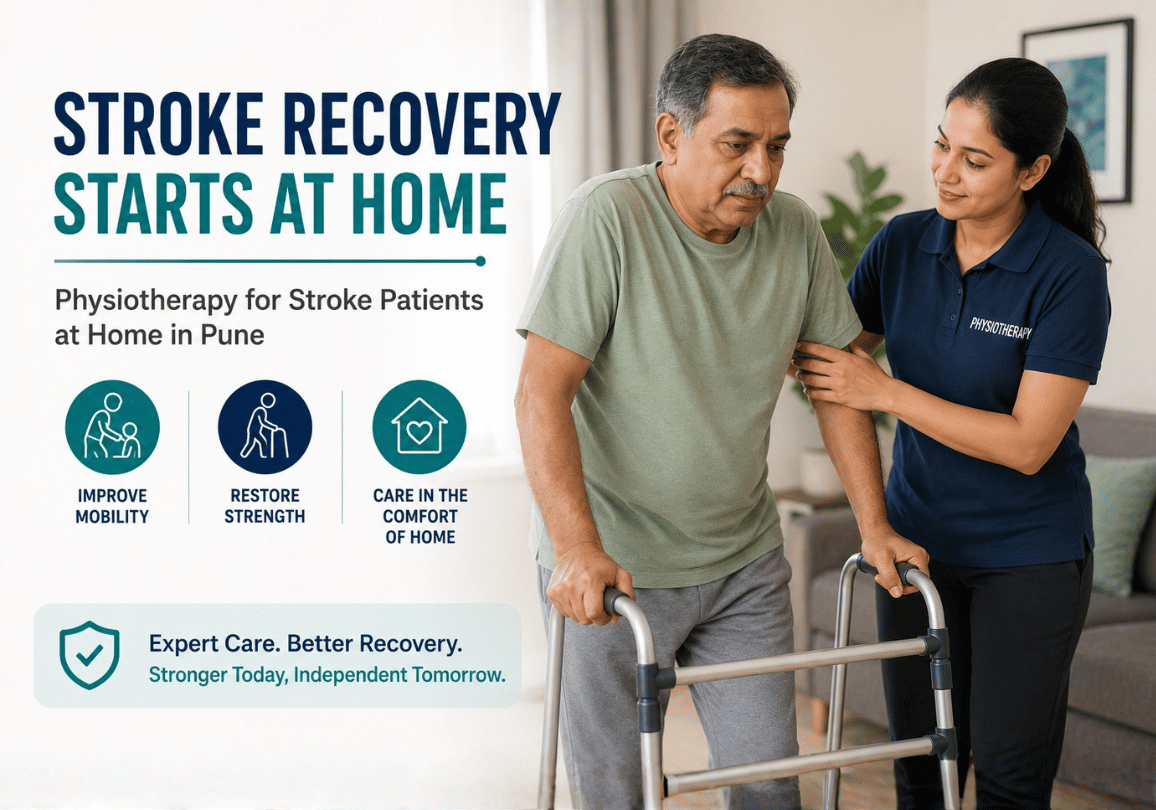
Physiotherapy for Stroke Patients at Home in Pune: A Practical Guide for Caregivers
Stroke is one of the most disabling medical events a person can experience, and for most families, recovery begins at home. Understanding physiotherapy for stroke patients at home in Pune is one of the most important things a caregiver can do, because the right rehabilitation, started at the right time, directly determines how much function a stroke survivor regains.
This guide explains how stroke rehabilitation at home works, why early physiotherapy matters, what exercises are safe to begin at home, how to prepare your home environment, and what warning signs require immediate medical attention.
Stroke in India: What Every Family Caregiver Should Know
Stroke ranks as India’s fourth leading cause of death and fifth leading cause of disability. According to a study published in Scientific Reports (Nature, 2024), the incidence of stroke in India ranges from 119 to 145 per 100,000 people annually, a figure higher than in many high-income countries.
A notable feature of stroke in India, highlighted by the same study, is that approximately 20-30% of strokes occur in people under the age of 50. In many families, the person recovering is not an elderly grandparent but a working parent in their 40s or 50s. The stakes for full recovery are therefore high, and access to structured physiotherapy at home can be the deciding factor in how completely a person regains independence.
What Physiotherapy for Stroke Patients at Home Covers
Home physiotherapy for stroke survivors is far more comprehensive than basic stretching or walking practice. A trained neurological physiotherapist will assess the patient’s specific deficits and design a programme across multiple areas:
- Mobility and gait: Walking pattern correction, use of walking aids, safe negotiation of stairs, transfers between bed, chair, toilet, and car.
- Upper limb function: Arm reaching, grasping, reducing spasticity (abnormal muscle stiffness), and restoring fine motor skills needed for dressing, eating, and writing.
- Balance and coordination: Sitting and standing balance, weight-shifting, proprioception training, and fall prevention.
- Spasticity management: Passive and active range-of-motion exercises to prevent contractures, which are permanent joint restrictions caused by untreated spasticity.
- Respiratory physiotherapy: Breathing exercises for patients recovering from prolonged bed rest or with cardiac and pulmonary complications.
- Activities of daily living (ADL): Self-care training including dressing, bathing, grooming, and safe kitchen use.
- Caregiver education: Teaching family members correct handling techniques, assisted exercise support, and how to recognise warning signs.
Phases of Stroke Rehabilitation at Home: What to Expect
Recovery from stroke does not follow a single path. There will be plateau periods and days with little visible progress. Understanding the typical trajectory helps caregivers hold a longer view and stay consistent when progress feels slow.
| Phase | Timing | Primary Goal | Key Activities |
| Phase 1
Early / Acute |
Weeks 1-4 post-discharge | Prevent complications; begin movement | Passive range-of-motion, ankle pumps, bed positioning, basic sitting balance, safe transfers |
| Phase 2
Sub-Acute |
Weeks 5-12 | Restore basic mobility; reduce spasticity | Assisted standing, heel slides, bridging, weight-bearing, supported walking, hand opening drills |
| Phase 3 Intermediate | Months 3-6 | Build functional independence | Unassisted walking, stair practice, ADL training, balance challenges, upper limb task training |
| Phase 4 Chronic / Ongoing | 6 months+ | Consolidate gains; prevent regression | Task-specific strengthening, community mobility, fall-prevention routines, maintenance exercise |
Your physiotherapist will reassess the patient at each phase transition and adjust exercise intensity, goals, and focus areas based on progress. What is appropriate in week two will be very different from what is appropriate in month four.
Post-Stroke Exercises at Home: A Caregiver’s Reference
The following exercises are commonly used in home-based stroke rehabilitation programmes. They are described here for caregiver education. Every exercise programme must be individually assessed and initiated by a qualified neurological physiotherapist before a caregiver attempts to guide it at home. Stop all activity immediately if the patient experiences chest pain, sudden dizziness, breathlessness, or any new neurological symptom, and call emergency services if in doubt.
- Passive range-of-motion (PROM) exercises: For patients with little or no movement in the affected limb. The caregiver gently moves the arm or leg through its full range at each joint, while the patient focuses on mentally imagining the movement. The MSD Manual notes these must be performed several times daily to prevent contractures in the hand and wrist.
- Ankle pumps: Suitable for all patients, including those on bed rest. The patient flexes and points both feet repeatedly, approximately 20 repetitions, three to four times daily. This promotes circulation and reduces the risk of deep vein thrombosis (DVT), a serious complication in patients with limited mobility.
- Heel slides: Lying on the back, the patient slowly bends the affected knee by sliding the heel toward the buttocks, then straightens it. The caregiver may gently guide the heel. This begins restoring the hip and knee flexion needed for walking. Target 10-15 repetitions per session.
- Bridging: Lying on the back with knees bent and feet flat, the patient tightens the buttock muscles and lifts the hips to form a straight line from shoulders to knees. Hold three to five seconds, then lower slowly. This builds core and hip-extensor strength, which are the foundational requirements for safe standing and walking.
- Sitting balance training: Sitting on the edge of the bed or a firm chair, the patient holds the position without hand support for increasing durations, starting at 10 seconds and gradually increasing. The caregiver stands close for safety. Progressive forward and lateral weight shifts are added under the physiotherapist’s guidance.
- Standing with support: For patients cleared for early standing by their physiotherapist. Using a walking frame or sturdy surface, the patient stands with the caregiver nearby. Equal weight through both legs is encouraged. Stroke survivors typically shift weight to the unaffected side, and the physiotherapist will use specific cues to correct this pattern.
- Upper limb table exercises: Seated at a table, the patient uses the unaffected hand to assist the affected arm through reaching and sliding movements. A cloth on a smooth table surface works well for gentle sliding drills. These functional, task-specific movements are particularly effective for neuroplasticity because they replicate real-world activities the brain is working to relearn.
Caregiver’s Role in Stroke Rehabilitation at Home
A Cochrane Review analysing nine randomised controlled trials found that caregiver-mediated exercises have a measurable positive effect on standing balance, quality of life, daily activities, and long-term walking distance. The researchers describe caregivers assisting with exercises as a low-cost, promising intervention that complements standard clinical care.
Effective caregiver involvement includes the following:
- Encourage effort, do not eliminate it. Doing too much for the patient reduces the neurological stimulation that drives recovery. The brain relearns through repeated, self-initiated movement, not through passive movement.
- Follow the physiotherapist’s prescribed programme consistently, including on days when progress feels absent. Recovery is cumulative over weeks and months.
- Keep a simple home exercise log: what was done, how long, and any concerns or changes you noticed. Share this with the physiotherapist at each visit.
- Remove trip hazards, secure loose floor mats, install bathroom grab bars, and ensure adequate lighting at night before any rehabilitation begins at home.
- Monitor for post-stroke depression. A systematic review published in PMC (2021) found the pooled prevalence of post-stroke depression in India is approximately 55%. Depression significantly impairs rehabilitation motivation and outcomes.
- Attend physiotherapy sessions where possible so you can learn correct technique directly from the physiotherapist, particularly for assisted exercises and safe transfers.
- Protect your own well-being. Caregiver depression is well-documented globally. Sustainable recovery support requires you to remain physically and emotionally functional.
Preparing Your Pune Home for Safe Stroke Rehabilitation
A home safety assessment is essential before beginning physiotherapy. Your physiotherapist will conduct this on the first visit. Key areas to address in advance include:
- Bathroom: Install grab bars beside the toilet and inside the shower or bath. Place non-slip mats on all wet surfaces. A handheld shower head makes bathing significantly safer.
- Bedroom: The bed height should allow the patient’s feet to rest flat on the floor when sitting on the edge. The path between bed and bathroom should be clear and well-lit.
- Flooring: Remove all loose rugs and floor mats from walking paths. Secure carpet edges. Clear cables, bags, and shoes from the floor.
- Lighting: Ensure bright lighting in all corridors. Install a night-light in the bathroom and bedroom hallway for overnight mobility.
- Stairs: A handrail on both sides is ideal. If the bedroom is upstairs and the patient has significant mobility limitations, temporarily relocate sleeping arrangements to the ground floor during early recovery.
- Seating: Replace low, soft sofas with firm, high chairs with armrests. These are significantly easier for stroke survivors to stand from.
Warning Signs: When to Stop Exercise and Seek Immediate Help
During home rehabilitation, caregivers must distinguish normal exercise discomfort from symptoms that require emergency attention. Stop all activity and call emergency services immediately if you observe any of the following:
- The patient describes a sudden, severe headache as the worst they have ever experienced.
- New weakness, numbness, or heaviness appearing on one side of the body.
- Sudden difficulty speaking, slurred speech, or inability to understand what is said.
- Sudden loss of vision in one or both eyes, or double vision.
- Sudden loss of balance or collapse without a clear physical cause.
- Chest pain, irregular heartbeat, or breathlessness at rest or with minimal activity.
- Fever above 38 degrees Celsius alongside any neurological change.
- Significant swelling, redness, or warmth in one calf may indicate deep vein thrombosis.
In all these situations, note the exact time symptoms began, do not give the patient food or water, and call emergency services. Rapid response is as critical in a second stroke event as in the first.
Why Choose Healyos for Stroke Rehabilitation at Home in Pune
Healyos is a home physiotherapy service established in Pune in 2015 under the guidance of Padma Vibhushan Dr. K.H. Sancheti, one of India’s most respected orthopaedic surgeons and the founder of the internationally recognised Sancheti Institute. With more than 21,000 patients treated, over 2,50,000 home sessions delivered, and a 4.9 out of 5 Google rating from over 1,100 verified patient reviews, It brings ISO-certified neurological physiotherapy directly to homes across Pune and Navi Mumbai, including Baner, Aundh, Wakad, Kothrud, Koregaon Park, Viman Nagar, Hadapsar, Hinjewadi, and Pimple Saudagar.
For stroke rehabilitation, we provide physiotherapists trained specifically in neurological conditions, including brain stroke rehabilitation, hemiplegia, paralysis treatment, and facial palsy. Patients can choose from physiotherapy at home, in-clinic sessions, or online consultations, depending on the stage of recovery and the patient’s mobility. Every programme begins with a thorough assessment, and caregiver education is built into every home visit.
Key Takeaways
- Approximately 20-30% of strokes in India affect people under 50, making full rehabilitation a high-priority goal for many working-age families.
- The first 3-6 months post-stroke are the period of peak neuroplasticity, but meaningful improvement is achievable beyond 12 months with consistent structured physiotherapy.
- A Cochrane Review confirms that caregiver-mediated exercises positively affect standing balance, quality of life, daily activities, and long-term walking distance.
- Home physiotherapy covers mobility, balance, upper limb function, spasticity management, ADL training, and caregiver education, not just exercise repetitions.
- Post-stroke depression affects approximately 55% of stroke survivors in India. It significantly impairs rehabilitation and must be identified and addressed promptly.
- Specific symptoms, including new one-sided weakness, sudden severe headache, speech difficulty, and chest pain, require immediate emergency care, not a wait-and-see response.
Frequently Asked Questions
Q1. How soon after hospital discharge can physiotherapy for stroke patients begin at home in Pune?
Physiotherapy can begin within 24-48 hours of returning home, provided the patient is medically stable and the treating neurologist has given clearance. The sooner structured rehabilitation starts, the better the long-term outcome.
Q2. How many home physiotherapy sessions does a stroke patient need per week?
Most stroke survivors benefit from daily or every-other-day sessions in the first 4-8 weeks post-discharge, moving to 3-4 sessions per week as recovery progresses. The exact frequency depends on stroke severity, patient tolerance, and rehabilitation goals. Your physiotherapist will recommend a plan at the initial assessment and adjust it over time.
Q3. Is home physiotherapy for stroke as effective as going to a clinic in Pune?
Yes, for most stroke patients. A systematic review published in ScienceDirect (2020) found high-quality evidence that home-based and clinic-based physiotherapy produce equivalent outcomes for daily activities and mobility. Home rehabilitation has an added benefit: patients practise real-life movements in the environment where they actually live. Healyos also offers in-clinic sessions for patients who need specialist equipment or parallel modalities.
Q4. My parent had a stroke 9 months ago and is still weak. Is it too late for physiotherapy in Pune?
No. While the first 3-6 months offer the fastest neuroplastic change, meaningful improvements in strength, balance, spasticity management, and fall prevention are achievable well beyond this window. Research shows recovery sensitivity extends past 12 months with consistent, structured input.
Q5. What is the difference between a neuro physiotherapist and a general physiotherapist?
A neurological physiotherapist has specialist training in conditions that affect the brain and nervous system, including stroke, Parkinson’s disease, and spinal cord injuries. They understand how neurological damage alters muscle tone, disrupts movement coordination, and affects balance and sensation.
Q6. How should a caregiver handle a fall during home exercise?
Do not attempt to lift the patient immediately. First check for consciousness and signs of injury to the head, hips, and wrists. If there is no injury and the patient is calm, assist them carefully to a sitting position using proper technique, then to a chair or bed. If the patient struck their head, cannot be moved safely, or shows any new neurological symptoms, call emergency services. Your Physiotherapist will conduct a fall risk assessment during the first visit and recommend specific prevention strategies.

Leave a Reply