 +919325609388

 +919325609388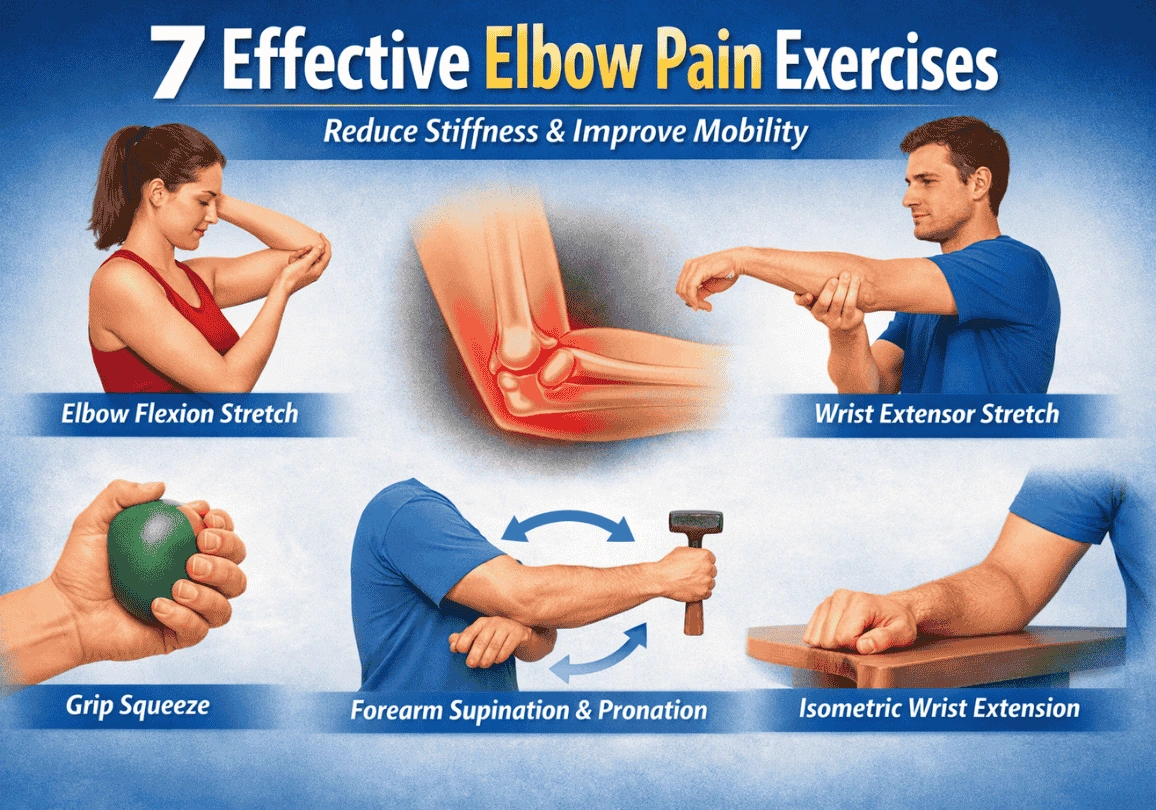
7 Effective Elbow Pain Exercises to Reduce Stiffness and Improve Mobility
If you’re dealing with persistent stiffness or soreness around the elbow, targeted elbow pain exercises can be one of the most effective ways to restore range of motion and reduce discomfort. This short guide focuses on seven practical moves that reduce stiffness, rebuild joint control, and make daily tasks easier. Each exercise is chosen to address common causes of elbow pain – overuse, tendon irritation, and tight forearm muscles – so you can practise safely at home and track progress.
Follow the step-by-step instructions below, including dosage, progression, and simple modifications. Warm up first, work within mild discomfort, and stop if you experience sharp pain. These elbow joint pain exercise options suit tennis or golfer’s elbow and general stiffness. Consistently performed, they help restore function and reduce flare-ups.
Understanding Elbow Pain And When Exercises Help
Elbow discomfort most commonly arises from repetitive strain (lateral epicondylalgia or “tennis elbow”), medial epicondylalgia (“golfer’s elbow”), acute injury, or degenerative change. Exercises aim to restore controlled motion, rebalance pronator/supinator and wrist muscle groups, and gradually load tendons to build tolerance.
Identifying the primary pain pattern (outside versus inside elbow) indicates the appropriate corrective focus and accelerates recovery.
7 Effective Exercises (How To Perform & Dosage)
Always begin with a brief warm-up: 3-5 minutes of gentle wrist and elbow circles, or light cardio such as brisk walking or arm cycling, to increase blood flow. Work within mild discomfort – stop if you experience sharp pain, new numbness/tingling, or increasing swelling. If symptoms are severe or persistent beyond several weeks, seek a clinician’s review before progressing.
- Elbow Flexion Stretch – Sit or stand and use the non-affected hand to bend the affected elbow slowly until a gentle stretch is felt at the front of the joint. Hold 20-30 seconds. Repeat 3 times, twice daily. This eases anterior capsule tightness and restores flexion range.
- Elbow Extension Stretch – Extend the arm and gently use the opposite hand or a towel to pull the fingers back, creating a stretch at the back of the elbow. Hold 20-30 seconds. Repeat 3 times, twice daily. This helps regain extension and reduces posterior tightness.
- Wrist Flexor Stretch – With the arm extended and palm facing up, use the other hand to pull the fingers down toward the floor until a gentle stretch is felt in the forearm. Hold 20-30 seconds. Repeat 3 times per side, two to three times daily. Beneficial for medial elbow strain.
- Wrist Extensor Stretch – Extend the arm with the palm down and gently guide the wrist into flexion with the other hand until a stretch is felt along the dorsal aspect of the forearm. Hold 20-30 seconds. Repeat 3 times per side, two to three times daily. Useful for lateral epicondylalgia.
- Forearm Pronation/Supination (rotation) – Sit with the elbow at 90°. Slowly rotate the forearm palm-up, then palm-down. Start with 10-15 repetitions in each direction; once painless, progress by holding a light hammer or small weight to increase the load. This restores rotational control around the elbow joint.
- Isometric Wrist Extension – Place the forearm on a table with the hand over the edge, palm down. Press the back of the hand into the table without moving the wrist (isometric contraction). Hold for 5-10 seconds, relax. Do 10 reps for 2 sets daily. Isometrics reduce tendon irritation while building strength.
- Grip Squeeze and Progressive Loading – Squeeze a soft ball or rolled towel 10-20 times per set for 2-3 sets. Progress to therapy putty or hand grippers as tolerated. Grip training strengthens forearm stabilizers and is central to many elbow pain relief exercises programs.
Progression And Programming
Begin with stretching and isometric exercises for the first 1-2 weeks, particularly during acute or painful stages. After pain subsides, add rotational and concentric loading (wrist curls; supination/pronation with light resistance) two to three times per week.
Increase resistance gradually: progress only when a full session produces muscular fatigue, not sharp next-day pain. Use RPE (Rate of Perceived Exertion) around 3-5/10 for early loading and advance from there.
These exercises align with common rehabilitation protocols that balance mobility, eccentric loading, and progressive strengthening for tendinopathy and stiffness. Eccentric loading and graded isometrics are particularly effective for many forms of tendon load intolerance.
Sample Daily Routine (10-15 Minutes)
Warm up 3-5 minutes with gentle wrist/elbow circles. Perform 2-3 stretches (flexion, extension, wrist flexor), holding each for 20-30 seconds. Add isometric wrist extension (10 reps) and grip squeezes (2 sets) to finish. Progress to pronation/supination drills or light wrist curls on alternate days once pain allows.
For lateral epicondylalgia (outside elbow), emphasise wrist extensor isometrics and eccentric wrist extensor loading once pain allows. For medial epicondylalgia (inside elbow), focus on wrist flexor control and gradual concentric work. Avoid heavy gripping or high-repetition loading until basic control and pain reduction are achieved.
Seek medical advice if you experience sharp worsening pain, new numbness/tingling, visible swelling, sudden loss of movement, or if symptoms persist beyond 6-8 weeks despite consistent home therapy. Also consult a clinician for any signs suggestive of nerve entrapment or suspected structural injury.
Top tips to make exercises work
- Keep sessions short and frequent rather than long and sporadic.
- Track symptoms and reps in a simple diary to spot trends.
- Use incremental increases in resistance – small steps prevent setbacks.
- Pair exercises with short periods of ice or heat, depending on which reduces symptoms.
- Prioritise the quality of movement over the number of repetitions.
Healyos: How We Help
At Healyos, our physiotherapists design personalized elbow joint pain treatment exercises and supervise progression to regain strength and mobility. We tailor programs whether your goals are hobby-level function, returning to manual work, or sport. Our plans include technique coaching, graded loading, and return-to-activity guidance to reduce the risk of re-injury.
Consistent, targeted elbow pain exercises restore motion, build forearm stability, and gradually increase load tolerance. Start with mobility and isometric control, progress to rotational drills and grip strength, and monitor symptoms weekly.
If progress stalls, seek a personalised assessment to refine the plan and address any structural issues. With patient, progressive work, most people regain meaningful function and reduce stiffness within weeks.

Leave a Reply