 +919325609388

 +919325609388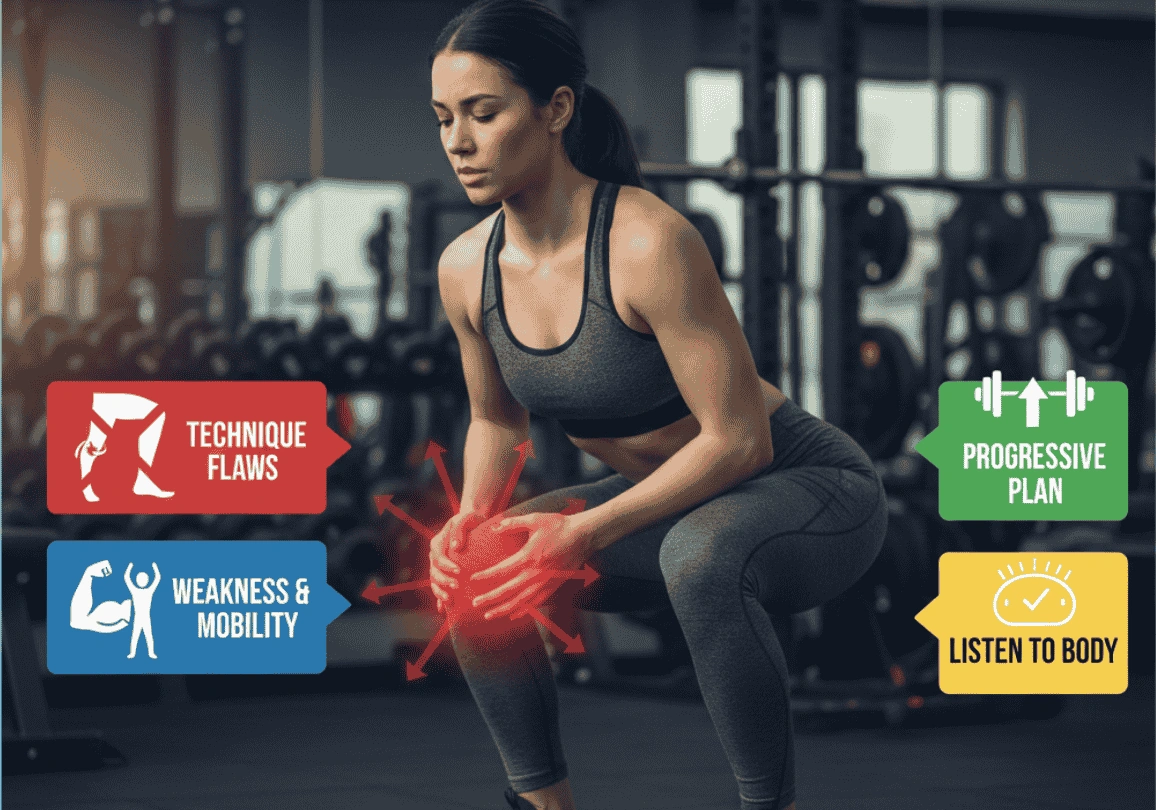
Knee Pain While Squatting: Causes, Mistakes, and How to Fix It
Knee pain while squatting is a common complaint among gym-goers and athletes, but it is rarely the squat itself that is solely to blame. Pain typically reflects technique flaws, muscle imbalances, mobility limits, or sudden load increases. This guide offers clear, practical steps for lifters and exercisers to identify causes, correct mistakes, and rebuild safe, pain-free squatting.
You’ll get immediate adjustments to reduce discomfort during squats, plus targeted mobility and strengthening drills to fix weak links. Included are form cues, troubleshooting for pain behind the knee when squatting, and a straightforward progression to restore load tolerance safely. Follow the steps and consult a clinician if pain persists. These methods help you return to training confidently and consistently without chronic setbacks.
Understanding The Mechanics Behind Knee Pain When Squatting
Squatting loads the knee under compressive and shear forces. When the muscles that support the hip and thigh are strong and coordinated, the load is distributed evenly across joints. But asymmetry, limited ankle dorsiflexion, or poor hip control concentrates stress on the patellofemoral joint or tendons. Recognising the mechanical reason – whether it is tracking issues, tendon overload, or deep joint compression – guides targeted fixes.
Common causes of knee pain during squats
- Patellofemoral overload: Excessive pressure under the kneecap from repeated deep flexion or poor tracking.
- Tendinopathy: Patellar tendon load becomes painful with high volume, especially after heavy squats.
- Meniscal irritation or prior injury: Structural problems can flare with increased compressive loads.
- Joint arthritis: Degenerative changes make deep loading uncomfortable.
- Posterior chain weakness: Weak glutes or hamstrings shift work to the knee and quadriceps.
Technique Mistakes That Commonly Cause Pain
Bad habits are often the simplest fix. Watch for knees collapsing inward (valgus), excessive forward lean of the torso, heels rising, and a lack of core bracing. Allowing the knees to drift violently past the toes, or forcing depth despite ankle restriction, also increases patellofemoral compression. Each fault has an easy cue: spread the floor, chest up, hinge at the hips, and maintain mid-foot pressure.
If pain occurs during squats, stop adding load. Reduce depth, slow the tempo, or switch to box squats to limit knee bend. Check shoes and stance – widen slightly and turn toes out a touch to improve tracking. Use temporary heel elevation (1-2 cm) if ankle mobility limits depth.
Always brace: inhale, brace core as if taking a punch, then descend. These changes often remove the pain-provoking factor within a session.
How To Fix Knee Pain From Squats With A Progressive Plan
Fixing knee pain after squats requires short-term protection and a medium-term strengthening strategy. Begin by offloading for several sessions: reduce weight and volume by 30-50% and avoid deep maximal sets. Focus on mastering unloaded squat mechanics until pain-free. Start targeted strength work for the hips and quads, and improve ankle mobility with wall dorsiflexion drills.
The practical tips and exercises below are consistent with common clinical recommendations and practical reviews. In practice, aim to keep rehabilitation sessions focused and measurable: use RPE (Rate of Perceived Exertion) to guide intensity, target moderate loads that produce fatigue without sharp pain, and schedule at least 48 hours between heavy lower-limb sessions to allow tendon recovery.
Monitor swelling and next-day soreness. If pain intensifies or mobility worsens despite these measures, reduce the load further and seek a physiotherapy assessment. Document how your knee responds to each adjustment so you and your clinician can identify effective changes and those that aggravate symptoms.
Strengthening Exercises: Build Support Around The Knee
- Glute bridges and single-leg bridges to restore hip extension and posterior chain power.
Clamshells or band walks to strengthen external rotation and resist knee valgus. - Short-arc quads and straight-leg raises for isolated quadriceps control without heavy joint compression.
- Step-ups, slow controlled split squats, and goblet squats to practise loaded single-leg control and functional strength.
Ankle dorsiflexion stretches, calf mobility, and hip flexor lengthening ease compensations that push the knee forward. Regular hamstring and quadriceps flexibility work reduces uneven forces on the patella. Use foam rolling for quads and IT band as a complement, not a cure.
When pain is controlled and activation exercises demonstrate improved control, gradually increase the load. Start with light goblet or box squats, increase the load by about 5-10% per week, and keep volume conservative for the first four weeks. Prioritise quality over numbers: stop sets early if form degrades. Add a targeted strength day and keep one complete rest day for tissue recovery.
Sample Four-Week Return-To-Squat Plan
Week 1: Technique focus – bodyweight box squats, 3×6-8; glute bridges 3×12; clamshells 3×15.
Week 2: Light load – goblet squats 3×6-8 at RPE 5; step-ups 3×8 each leg; ankle mobility drills daily.
Week 3: Moderate load – front or trap-bar squats 3×5 at RPE 6-7; single-leg Romanian Deadlifts 3×8; continue mobility.
Week 4: Reassess pain and form. If pain-free, gradually increase back squat load with conservative volume and an ongoing strength routine.
Posterior knee pain often points to hamstring tendon stress, Baker’s cyst, or posterior capsule irritation. If you feel pain behind the knee, reduce flexion, avoid deep pauses at the bottom, and use a monitored progression. Persistent posterior pain warrants clinical examination to exclude meniscal or cystic causes.
If pain persists beyond two weeks despite conservative changes, or if you have joint swelling, mechanical locking, numbness, or instability, seek physiotherapy or orthopedic review. Early imaging may be indicated for suspected meniscal tears or ligament damage.
Quick checklist: immediate and longer-term fixes
- Stop adding load if pain spikes.
- Check stance, brace, and shoe choices.
- Improve ankle mobility before forcing depth.
- Strengthen hips and quads with controlled exercises.
- Progress load conservatively and monitor symptoms.
Healyos: How We Support A Safe Return To Squats
At Healyos, we assess squat mechanics, design targeted hip and leg-strength plans, and guide load progression tailored to your sport or goals. Our focus is on restoring confidence and pain-free squatting through measurable milestones and frequent technique checks.
In summary, knee pain while squatting usually reflects fixable factors – technique, weakness, mobility limits, or sudden overload – rather than an unavoidable consequence of squatting. Use immediate adjustments to remove pain, follow a targeted strengthening and mobility plan, and progress load conservatively to rebuild tolerance.
If pain persists or red flags appear, seek professional review to rule out structural injury. With careful work, you can fix knee pain while squatting and return to lifting stronger and safer.

Leave a Reply