 +919325609388

 +919325609388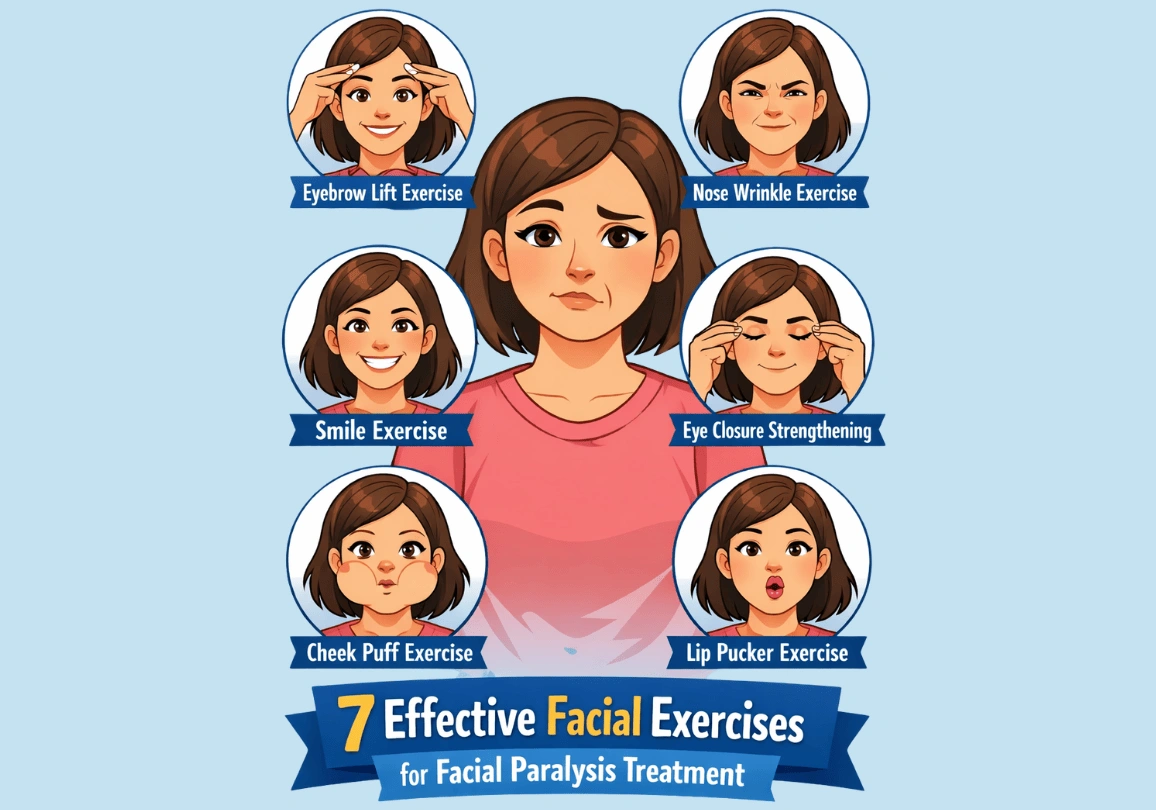
7 Effective Facial Exercises for Facial Paralysis Treatment
Facial paralysis can significantly impact your quality of life, affecting everything from your smile to your ability to close your eyes. The good news? Facial paralysis exercises can help restore muscle function, improve symmetry, and accelerate recovery.
These targeted movements work by retraining facial muscles, improving blood circulation, and stimulating the affected nerves.
Understanding Facial Paralysis and the Role of Exercise
When the facial nerve is damaged—whether from Bell’s palsy, stroke, trauma, or surgery—the muscles it controls become weak or completely immobile. This leads to drooping, asymmetry, and difficulty with basic facial movements.
Facial exercises for facial paralysis serve multiple purposes:
- Prevent muscle atrophy and stiffness
- Retrain neural pathways between the brain and facial muscles
- Improve coordination and control
- Enhance blood flow to affected areas
- Reduce the risk of synkinesis (unwanted muscle movements).
7 Most Effective Facial Paralysis Exercises
1. Eyebrow Lift Exercise
This foundational exercise targets the frontalis muscle, helping you regain control of eyebrow movement.
How to perform:
- Place your index finger just above each eyebrow
- Gently try to raise your eyebrows while providing slight resistance with your fingers
- Hold for 5 seconds, then relax
- Repeat 10 times, three times daily
Pro tip: If you can’t move the affected side at all initially, use your fingers to manually lift the eyebrow while mentally focusing on the movement. This helps maintain the mind-muscle connection.
2. Eye Closure Strengthening
Many people with facial paralysis struggle to fully close the affected eye, which can lead to dryness and irritation.
How to perform:
- Gently close both eyes as if falling asleep (avoid squeezing tightly)
- Hold for 5 seconds
- Slowly open your eyes
- Repeat 10-15 times, several times throughout the day
Important note: If you cannot close your eye completely, use lubricating drops and discuss protective measures with your doctor to prevent corneal damage.
3. Nose Wrinkle Exercise
This movement activates the muscles around the nose and upper lip, which are often affected by facial paralysis.
How to perform:
- Wrinkle your nose as if smelling something unpleasant
- Try to move both sides equally
- Hold for 5 seconds
- Relax and repeat 10 times
Focus on slow, controlled movements rather than speed. Quality matters more than quantity with facial nerve paralysis exercises.
4. Cheek Puff Exercise
This exercise strengthens the buccinator muscles in your cheeks and helps with lip closure.
How to perform:
- Take a deep breath and puff out both cheeks with air
- Hold the air in your cheeks for 5-10 seconds
- Slowly release the air
- Repeat 10 times
Variation: Try moving the air from one cheek to the other, which adds an extra challenge and works different muscle groups.
5. Smile Exercise
Rebuilding your smile is often a primary goal in facial paralysis recovery.
How to perform:
- Smile gently, trying to lift both corners of your mouth equally
- Hold for 5 seconds
- Relax your face completely
- Repeat 10 times, focusing on symmetry
Start with small movements and gradually increase the range as your strength improves. Avoid overworking the unaffected side, which can lead to increased asymmetry.
6. Lip Pucker Exercise
This exercise strengthens the orbicularis oris muscle around your mouth.
How to perform:
- Pucker your lips as if preparing to kiss or whistle
- Try to make the movement symmetrical on both sides
- Hold for 5 seconds
- Relax and repeat 10-15 times
Advanced variation: Once you’ve mastered the basic pucker, try alternating between a pucker and a wide smile to improve muscle coordination.
7. Neck and Jaw Tension Release
While not directly targeting facial muscles, this exercise reduces compensatory tension that often develops during facial paralysis.
How to perform:
- Gently tilt your head toward the unaffected side, stretching the affected side
- Hold for 15-20 seconds
- Return to center and tilt toward the affected side
- Perform gentle jaw opening and closing movements
- Repeat the sequence 5 times
This helps prevent stiffness and maintains overall facial mobility during recovery.
Creating Your Exercise Routine
Consistency is key when performing facial paralysis exercises. Here’s a sample daily routine:
Morning (10 minutes):
- Eyebrow lifts – 10 reps
- Eye closure – 15 reps
- Nose wrinkles – 10 reps
Midday (10 minutes):
- Cheek puffs – 10 reps
- Smile exercise – 10 reps
- Lip puckers – 15 reps
Evening (10 minutes):
- Repeat morning routine
- Add neck and jaw release – 5 reps
Important Tips for Success
Do:
- Perform exercises in front of a mirror to monitor symmetry
- Start slowly and gradually increase repetitions
- Stay consistent with your daily routine
- Be patient—recovery can take weeks to months
- Document your progress with photos
Don’t:
- Overstrain or force movements
- Exercise to the point of pain or fatigue
- Neglect the affected side by favoring the strong side
- Skip your routine, even on days you feel discouraged
- Compare your recovery timeline to others
Complementary Treatments
While facial paralysis treatment exercises form the foundation of recovery, they work best when combined with other therapies:
- Physical therapy: Professional guidance ensures proper technique
- Massage: Gentle facial massage can improve circulation and reduce stiffness
- Electrical stimulation: May help with nerve regeneration in specific cases
- Biofeedback: Helps you learn to control facial muscles more effectively
Key Takeaways
- Facial exercises for facial paralysis are essential for recovery, helping retrain muscles and restore function
- Start exercises only after medical clearance and ideally under professional guidance
- Consistency matters more than intensity—perform exercises 2-3 times daily
- Focus on symmetry and controlled movements rather than speed or force
- Recovery timelines vary significantly; patience and persistence are crucial
- Combine exercises with other recommended treatments for optimal results
- Monitor your progress and adjust your routine as you improve
- Never exercise through pain or significant fatigue
Frequently Asked Questions
Q: Can facial paralysis exercises make my condition worse?
A: When performed correctly and with medical guidance, facial nerve paralysis exercises should not worsen your condition. However, overexertion or incorrect technique can lead to synkinesis (abnormal facial movements) or increased asymmetry. This is why working with a trained physical therapist, especially initially, is so important. They can ensure you’re performing movements correctly and not overcompensating with your unaffected side.
Q: How long does it typically take to see results from facial paralysis exercises?
A: Recovery timelines vary significantly depending on the cause and severity of paralysis. Some people notice subtle improvements within 2-3 weeks, while others may need several months. Bell’s palsy patients often see significant recovery within 3-6 months, while surgical nerve injuries may take longer. The key is maintaining consistency even when progress seems slow. Most experts recommend giving any exercise program at least 6-8 weeks before evaluating its effectiveness.
Q: Are there any devices or tools that can enhance facial exercise effectiveness?
A: Yes, several tools can complement your exercise routine. Biofeedback devices help you visualize muscle activity and improve control. Some patients use therapeutic tape to provide sensory feedback. Mirror therapy and smartphone apps can track your progress with photos and videos. Neuromuscular electrical stimulation (NMES) devices may be prescribed in certain cases, though their use in facial paralysis is debated. Always discuss any devices or tools with your healthcare provider before incorporating them into your treatment plan.
Q: Can I perform facial exercises if I have synkinesis?
A: If you’ve developed synkinesis (unwanted muscle movements, such as your eye closing when you smile), you need specialized retraining exercises rather than standard strengthening exercises. Standard exercises can actually worsen synkinesis. Seek out a neuromuscular retraining specialist who can teach you selective muscle control techniques, which focus on isolating specific facial movements and preventing unwanted co-contractions. These specialized programs have different goals and techniques than typical facial paralysis exercises.
Q: Is it ever too late to start facial exercises after paralysis?
A: While earlier intervention generally yields better results, it’s rarely too late to benefit from facial paralysis exercises. Even chronic cases (more than a year old) can see improvements with dedicated exercise programs, though progress may be slower. Some patients begin exercises years after their initial injury and still experience enhanced function, reduced tightness, and improved quality of life. The facial muscles and nerves retain some capacity for retraining even long after the initial injury, so it’s worth trying regardless of how much time has passed.

Leave a Reply